Bali and Lombok
Two neighboring islands with contrasting characters: Hindu Bali, dense with temples and rice paddies, and Muslim Lombok, dominated by the Rinjani volcano and its still-quiet beaches.
Bali and Lombok form two neighboring islands in the Lesser Sunda Islands, separated by the Lombok Strait, which plunges to 1,300 meters and marks the Wallace line between Asian and Australasian fauna. Our team has worked these two destinations from our Denpasar office, and we present them together because they combine beautifully over 12 to 15 days, while offering very different atmospheres.
Bali can be crossed in three hours of road travel from north to south, but this compactness is deceptive. The island houses more than 20,000 Hindu temples, terraced rice paddies still irrigated by the subak, a cooperative system inscribed on UNESCO's list since 2012, and a central volcanic chain dominated by Gunung Agung (3,142 meters) and Batur (1,717 meters). Ubud, at 600 meters altitude in the heart of the island, remains the cultural hub: painting workshops in Penestanan, legong dances in the Royal Palace courtyard, morning flower markets for the canang sari offerings. Around it, the rice fields of Tegallalang and Jatiluwih still structure the landscape.
The north coast and east coast maintain a slower pace. In Amed, fishermen set out in jukung, outrigger canoes, from four in the morning for tuna, and diving happens directly from the beach on the wreck of the USAT Liberty in Tulamben. Pemuteran, at the far northwestern tip, is home to one of Southeast Asia's oldest Biorock artificial reef projects. To the south, Bukit Peninsula concentrates the surf breaks of Uluwatu and Bingin, with limestone cliffs rising 70 meters. Canggu and Seminyak bear the weight of tourism: we rarely send our travelers there for more than one or two nights, unless specifically requested.
Lombok, 35 minutes by flight or four hours by fast ferry from Bali, changes register entirely. The island is predominantly Muslim Sasak, density drops, and the Rinjani (3,726 meters) dominates the north. Its classic three-day, two-night trek passes through the Segara Anak crater, a lake at 2,000 meters altitude that harbors sulfurous hot springs. The south, around Kuta Lombok (not to be confused with Kuta Bali), retains deserted beaches like Mawun or Selong Belanak, and the weaving villages of Sade and Sukarara continue the ikat songket tradition on foot looms.
The three Gili Islands, northwest of Lombok, round out the package: Gili Trawangan for action, Gili Meno for tranquility, Gili Air for balance. No cars, no motorbikes—travel by cidomo (horse cart) or bicycle. Snorkeling with green sea turtles happens 15 meters offshore, no boat needed. Gastronomically, Bali defends babi guling (suckling pig roasted with spices) and bebek betutu (duck smoked in banana leaves), while Lombok lives up to its name (lombok means chili pepper) with ayam taliwang, grilled chicken with Lombok chili, originating from the Karang Taliwang district in Mataram.
Economically, Bali depends on tourism for over 50%, which has accelerated land pressure in Canggu and Ubud. Lombok remains more agricultural: tobacco, rice, pearls from the brackish waters of Sekotong Bay. We guide our travelers toward areas where visitor numbers remain measured, favoring family guesthouses in villages over beachfront complexes.
To discover
Rinjani trek to the crater. Three days of climbing from Senaru, one night on the crater rim at 2,641 meters, descent toward Lake Segara Anak and its hot springs. Reserved for experienced hikers, cumulative elevation gain of 2,000 meters.
Rice fields and subak around Jatiluwih. Two to three hour walk through the Jatiluwih terraces, at 700 meters altitude on the south slopes of Batukaru. The irrigation channels, managed collectively since the 9th century, still set the rhythm of harvests.
Diving on the Liberty wreck in Tulamben. American cargo ship torpedoed in 1942, resting between 5 and 30 meters, 25 meters from shore. Shore dive, accessible to beginners with guidance, with schools of trevally and hawksbill turtles at sunrise.
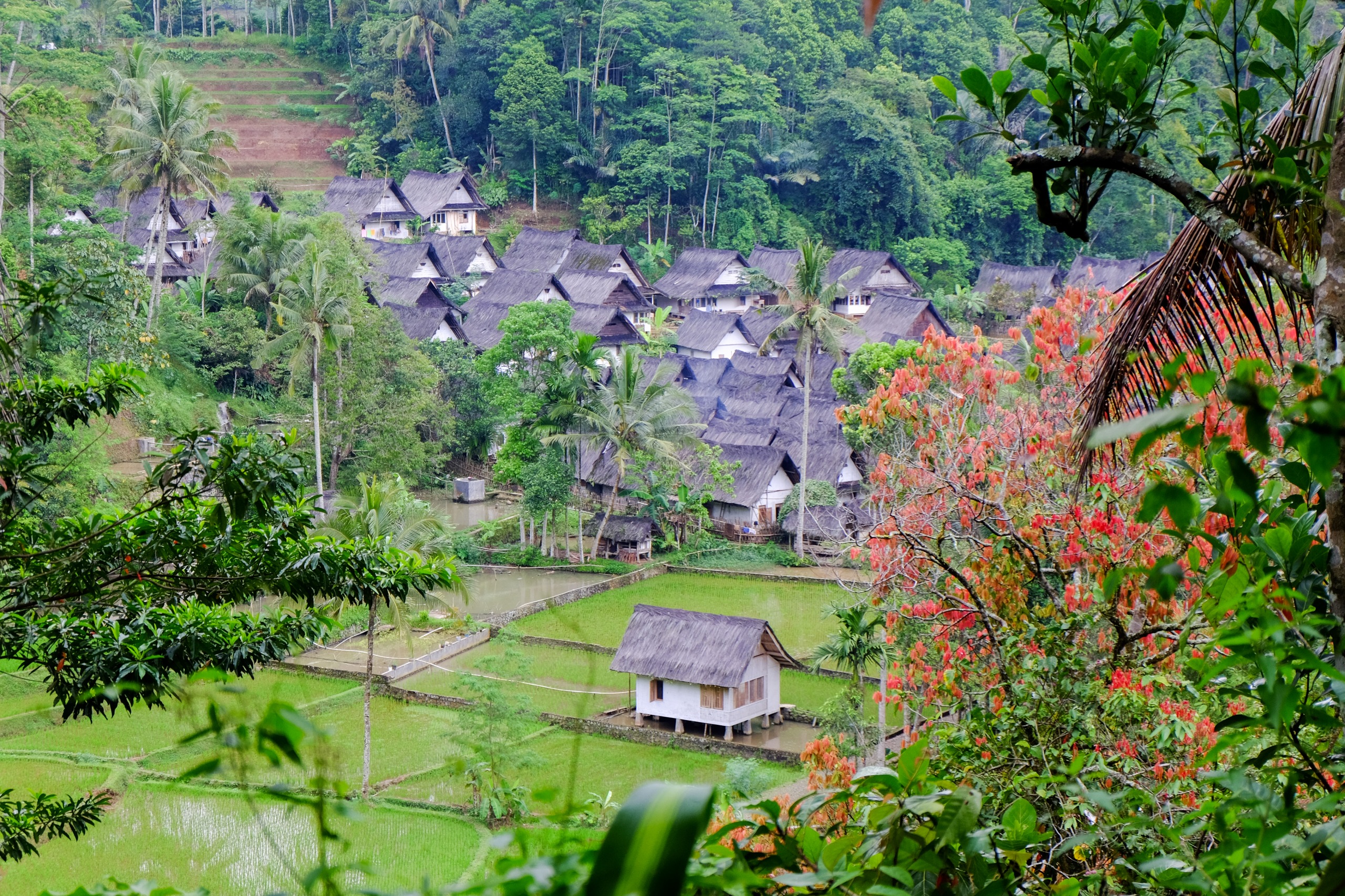
Sasak villages in southern Lombok. Thatched-roof houses and rice granaries (lumbung) in Sade and Ende, looms in interior courtyards. Women learn weaving from age nine, a customary requirement for marriage among the Sasak.
Ceremony at Tirta Empul temple. Purification bath in pools fed by a sacred 10th-century spring, 30 minutes north of Ubud. Our team organizes guided participation with a Balinese priest, sarongs and offerings included.
When to go
The dry season runs from April to October, with a stable core from May to September: 28 to 30°C on the coasts, moderate humidity, clear skies in the morning. This is the period we recommend for the Rinjani trek (trails officially close from January to March due to rain and landslide risk) and for diving at the Gilis, where visibility exceeds 25 meters. July and August concentrate European and Australian visitors, with marked increases in hotel rates in Ubud and the Gilis.
The rainy season, November to March, doesn't forbid travel but modifies it. Showers often fall late afternoon, brief and heavy, and temperatures remain around 27°C. January and February are the wettest months, with 300 to 400 mm of monthly rainfall in Ubud. Absolutely avoid: Nyepi, the Balinese day of silence (in March, date varies by the Saka calendar), when the airport closes for 24 hours, no vehicles circulate, and even lights stay off. At altitude, in Ubud or Munduk (800 meters), nights drop to 20°C year-round—pack a light fleece.
Practical tips
We recommend a minimum of 10 days for Bali alone, and 14 to 16 days for the Bali and Lombok combination with the Gilis. Below that, travel times (two hours between Ubud and the east coast, ferry or flight to reach Lombok) eat too much into your stay. The entry point is Ngurah Rai International Airport in Denpasar, well served from Europe via Singapore, Doha or Dubai. From Lombok, Praya Airport allows you to depart directly without returning to Bali—an option we often use to optimize itineraries.
The smoothest combination includes Java (Denpasar-Yogyakarta flight, 1h15) to add Borobudur and Bromo, or Komodo and Flores (Denpasar-Labuan Bajo flight, 1h15) for dragons and diving. Sumatra and Sulawesi require more flight time and are best planned on three-week minimum trips. Comfort levels are comprehensive in Bali, from family homestays at €25 per night to villas with private pools, more rustic but authentic on Lombok outside Senggigi and Kuta zones. Bali and Lombok suit families (with children from age six), culture-minded contemplatives, and trekkers for Rinjani and Batur alike. Travelers seeking absolute calm do well to avoid the Kuta-Seminyak-Canggu triangle and favor Sidemen, Munduk or the east coast.