Puri Saraswati Temple
Puri Saraswati Temple
In the heart of Ubud, Puri Saraswati Temple and its lotus pond embody Balinese art and spirituality. Dedicated to the goddess of knowledge, it also hosts traditional dance performances in the evening.
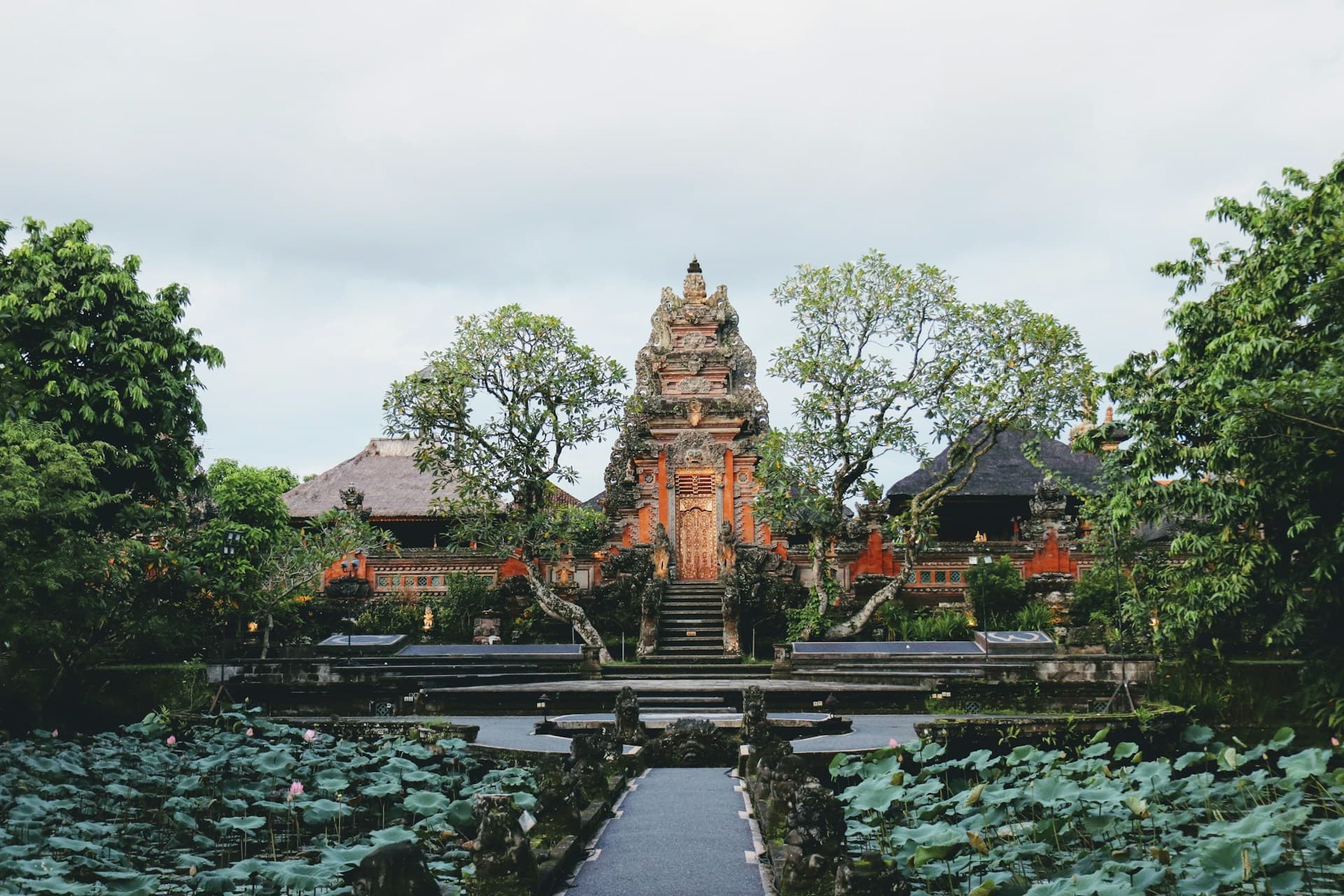
In the heart of Ubud, Puri Saraswati Temple rises beside a lotus pond that mirrors it like a living green reflection. Dedicated to Saraswati, the Balinese goddess of knowledge, arts and wisdom, it forms part of Ubud's royal palace complex. Its architecture of carved andesite stone, thatch-roofed pavilions and blooming water lilies make it one of Bali's most photographed temples — though it remains an active place of worship, never purely a tourist attraction.
Practical information at a glance
- Entry : symbolic contribution requested (suggested donation at entrance)
- Dress code : sarong and sash at the waist required — provided at entrance if needed
- Suggested duration : 30 to 45 minutes for a self-guided visit
- Access : in central Ubud, walking distance from the craft market and royal palace
- Dance performances : kecak or legong dance performances held in the evening within the temple grounds (separate ticket office)
What you'll see
The lotus pond makes an immediate impression: dozens of pink and white flowers float on dark water, framed by statues of deities. Beyond it, the candi bentar (split gateway) opens onto the inner courtyard. Carved reliefs on the walls depict scenes from Hindu-Balinese mythology. In the evening, torches illuminate the pavilions during traditional dance performances.
History and context
The temple was built in the twentieth century by Ubud's royal family, the Sukawati, to honor Saraswati. It forms part of the royal palace complex (puri), serving as the sanctuary dedicated to the arts. The goddess Saraswati is celebrated each year during the Saraswati festival, a time when books and musical instruments are blessed throughout Bali.
Highlights of your visit
The lotus pond at dawn
Early morning, before the crowds arrive, the lotus flowers are in full bloom and raking light gilds the sculptures. This is the calmest and most photogenic moment of the day.
The carved reliefs
The volcanic stone panels depict Saraswati holding her vina (lute), surrounded by swans and peacocks. Each detail is carved by hand according to classical Balinese artistic tradition.
Evening dance performances
Local troupes perform regularly in the temple courtyard. The legong dance in particular features young dancers in golden costumes — a spectacle rooted in Ubud's royal tradition.
Etiquette and visitor guidelines
- Wear a sarong and sash covering the waist — mandatory, provided at entrance
- Do not enter prayer areas during active ceremonies
- Remain silent and respectful around offerings and praying devotees
- Do not step on offerings (canang sari) placed on the ground
- Women during menstruation are traditionally requested not to enter the sacred grounds
Photography tips
Morning light (before 9 a.m.) is ideal: the sun illuminates the sculptures front-on and the lotus flowers are open. In the evening, torches create warm atmosphere but focusing becomes tricky. Avoid using flash inside pavilions. The reflection of the gateway in the lotus pond is best captured from the left side of the approach path.
Location and access
The temple sits on Jalan Kajeng, steps away from Ubud's royal palace and the central craft market. Ubud is accessible from Denpasar or Ngurah Rai Airport by car or taxi (approximately 1 hour depending on traffic). No direct public transport from the airport. Accessibility for people with reduced mobility is limited due to steps and uneven surfaces.
Nearby attractions
- Ubud Royal Palace (Puri Saren Agung) — a few metres away, seat of the Sukawati royal family, open to visitors.
- Ubud Market — opposite the palace, Balinese crafts, spices and textiles.
- Ubud Monkey Forest — nature sanctuary 15 minutes' walk to the south.
- Puri Lukisan Museum — Bali's first art museum, a few minutes' walk away, with collections of traditional paintings.
Frequently asked questions
A symbolic donation is generally requested at the entrance. Sarong and sash are provided free of charge if you don't have your own.
A sarong covering the legs and a sash around the waist are mandatory. These are available at the entrance if you don't bring your own.
Early morning, before 9 a.m., the site is noticeably quieter. The lotus flowers are also in full bloom at this time.
Yes, traditional Balinese dance performances (legong, kecak) are held regularly in the evening in the temple courtyard. Tickets are purchased separately, usually on-site or through local Ubud agencies.
Access is limited: the path along the lotus pond is passable, but inner courtyards feature steps and uneven surfaces.
Easily. The royal palace, craft market and Puri Lukisan Museum are all within a 10-minute walk. The Monkey Forest is accessible in 15 minutes.
Interested in this visit?
We can include it in your personalised itinerary.