Mount Samalas or the Solved Mystery of the Phenomenal 13th-Century Eruption
Azimuth Adventure Travel Ltd, in partnership with K-MerahProd (an audiovisual production company), regularly welcomes Western television crews to assist them in filming documentaries on Indonesie, which remains a little-known destination even as tourism develops at full speed
Azimuth Adventure Travel Ltd, in partnership with K-MerahProd (an audiovisual production company), regularly welcomes Western television crews to assist them in filming documentaries on Indonesie, which remains a little-known destination even as tourism develops at breakneck speed.
In September 2019, we helped a Galaxie Presse team produce a documentary on Indonesie's volcanoes, in which the story of Mount Samalas features prominently, following our suggestions during shoot preparation. This is therefore an opportunity for us to tell you more about this volcanic cone, whose name was still unknown to scientists just 20 years ago!
400 volcanoes in Indonesie!
Indonesie is a well-known destination for volcano enthusiasts. Approximately 400 mountains of fire dot the archipelago, some of which, like the Merapi , north of the city of Yogyakarta on the island of Java, rank among the most active and closely monitored on the planet (127 volcanoes are currently considered active in Indonesie).
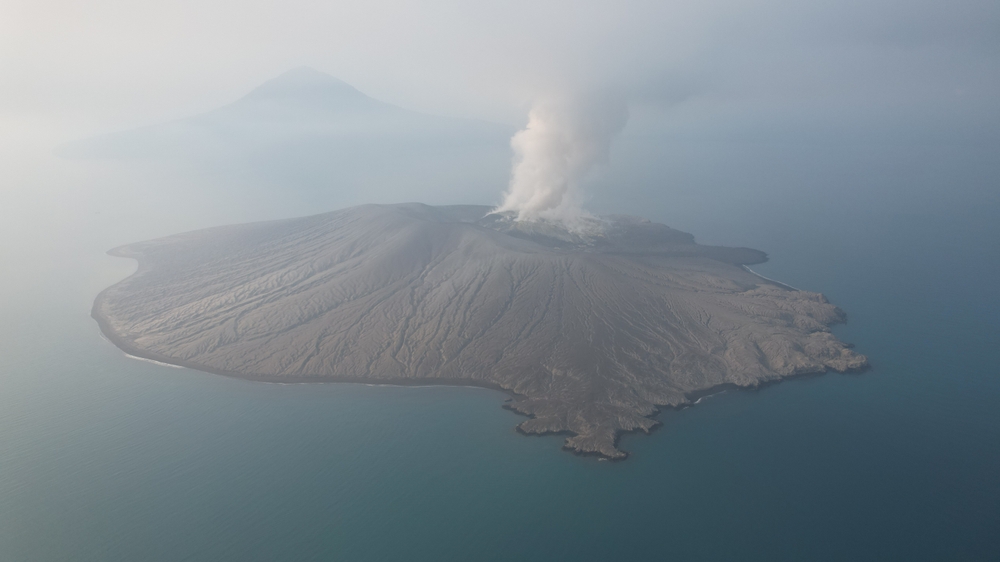
This is because the archipelago has been the scene, more than once over the last millennium, of phenomenal eruptions with planetary repercussions. The most recent well-documented ones are the Krakatoa eruptions in 1883 and that of Mount Tambora a few decades earlier, in 1815.
1257, the year of one of the greatest eruptions of all time
As early as the 1970s, volcanologists, climatologists, and glaciologists from around the world were certain that a large-scale eruption had occurred in the year 1257. Analysis of ice cores extracted from the Arctic and Antarctica led specialists to consider the eruption eight times more powerful than Krakatoa's, and twice as significant as Tambora's, yet they could not locate the source of such a cataclysm.
European chronicles of the period, such as that written by Brother Richer, a Benedictine monk in the Vosges, describe constantly cloudy skies for several months, a sudden drop in temperatures, and a year without summer, during which crops were particularly poor.
In London, the discovery of giant mass graves confirmed the existence of an unprecedented famine. In that city alone, 15,000 people died in the year following the explosion—a third of the population.
The mystery finally unveiled

It wasn't until 2003 that an international research team coordinated by the Physical Geography Laboratory in Meudon shed light on the mystery of the most significant eruption of the last seven millennia: by cross-referencing data from various fields and of differing nature (deposit distribution maps, 3D reconstruction of the ancient collapsed volcano, volume and mass flux of the eruption, comparison of the composition of glassy particles in the volcano's ash with those of glassy particles found in polar ice and historical documents), the team succeeded in identifying Mount Samalas, located on the island of Lombok , as responsible for this gigantic eruption. The volcano's name was revealed by a chronicle of the period written in Old Javanese (Babad Lombok), reporting a phenomenal eruption that year. The writings describe incessant earthquakes lasting a week, landslides on the flanks of Mount Rinjani, and the collapse of Mount Samalas, as well as scenes of panic and the flight of inhabitants to more distant areas.
In 2017, an article published in the British scientific journal Nature Geoscience nonetheless contributed to relativizing the eruption's impact on the climate changes of the period: the study of historical documents from that time would have demonstrated that "the Little Ice Age" actually preceded the eruption, with the eruption only aggravating the existing crisis without being its main factor.
Somewhere within the Rinjani volcanic complex, the city of Pamatan, the former capital of the Kingdom of Lombok buried at the moment of the eruption, awaits its resurrection from the ashes...