Focus on 4 Ethnic Groups of Indonesia
A vast archipelago of a thousand faces, Indonesia will continue to astonish you with its ethnic and cultural diversity. Shaped by a rich historical past, the country has always been at the heart of Southeast Asian
A vast archipelago of a thousand faces, Indonesia will continue to astonish you with its ethnic and cultural diversity. Shaped by a rich historical past, the country has always been at the heart of commercial and cultural exchanges in Southeast Asia. Arabs, Indians, Chinese, and Europeans also contributed to spreading their cultures within the Indonesian islands. This blend thus forms the basis of the incredible differences in lifestyles and beliefs that shape the daily lives of the archipelago's peoples. Here are four Indonesian ethnic groups that continue to captivate the curiosity of travelers!
The Batak

, Sumatra, photo © Lenisecalleja Photography via Shutterstock
Located in northern Sumatra, the Batak form an ethnic group comprising nearly 6 million people. Divided into six different groups descended from the same ancestors, they do not speak the same language and do not share the same customs. Their patriarchal society is made up of several clans called marga. To strengthen alliances, marriages are only permitted between members of different clans, and the woman joins her husband's clan.
Once animist and cannibalistic, the majority of the Batak are now Protestant, while in the South, a minority practices Islam. However, all continue to practice the adat, which refers to animist rites celebrating the veneration of ancestors.
The Batak are a proud warrior people. Indeed, their presence within the Indonesian military is very significant.
Having long remained isolated from the rest of the archipelago and European influence, the Batak possess refined craftsmanship. The architecture of their traditional wooden houses is particularly renowned. Some see in the special shape of the roof a horse saddle, a boat, or a sail. Judge for yourself!
The Minangkabau

Minangkabau, in Padang, photo © KiwiGraphy Studio via Shutterstock
One of the world's most significant matriarchal societies, the Minangkabau ethnic group lives in western Sumatra, as well as on the Riau Islands. Approximately 6 million people belong to this group. Moreover, the Minangkabau are also present in Malaysia. The majority of them practice Islam.
"Minang" means "victorious" and "kabau" means "buffalo." This name is said to come from a legend recounting the battle of two buffalo, one belonging to the Minangkabau and the other to the Majapahit kingdom. As victory went to the former, they decided to make the animal their sacred emblem. In fact, signs of it are found everywhere, notably in Minangkabau culture. For example, the roofs of their traditional houses take the shape of buffalo horns.
In this society, women are the leaders! They are thus the only ones able to own land and real and personal property. Men are encouraged to leave to seek fortune, and from a young age they are pushed to travel and discover the world. This is one of the reasons why many intellectuals and political figures have Minangkabau origins! The ethnic group actively participated in Indonesian independence after World War II.
It is notably highly recognized for its culinary and artistic culture. It gave us rendang, soto, and sate Padang! A treat for the palate! In terms of theatrical art, Randai also originates from the Minangkabau region. A harmonious blend of dance, martial arts, and stagecraft, it strongly contributes to the cultural influence of this people in Indonesia.
The Sasak
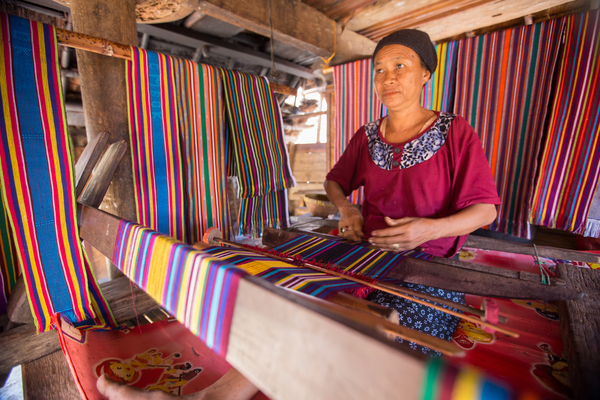
A Sasak woman weaving an ikat, Lombok, photo © I AM CONTRIBUTOR via Shutterstock
The most widespread ethnic group on the island of Lombok, the Sasak are primarily farmers. Divided into two distinct groups, namely the Wetu Telu with animist customs and the Wetu Lima, they number approximately 2.5 million inhabitants. Their agricultural culture consists mainly of rice, coconut, sugarcane, and coffee.
A large part of the Sasak are Muslim, unlike the Balinese who are Hindu. Their language is very similar to that spoken in Bali and Sumbawa. However, the dialect varies depending on the region.
The Sasak are also well known for their annual festival Bau Nyale, which typically takes place in February or March. This is a ritual celebrated in favor of upcoming rice harvests and involves the appearance of nyale. These are sea worms that the Sasak fish and taste to celebrate forthcoming and abundant harvests. Not to be missed if you have the opportunity!
The Dayak
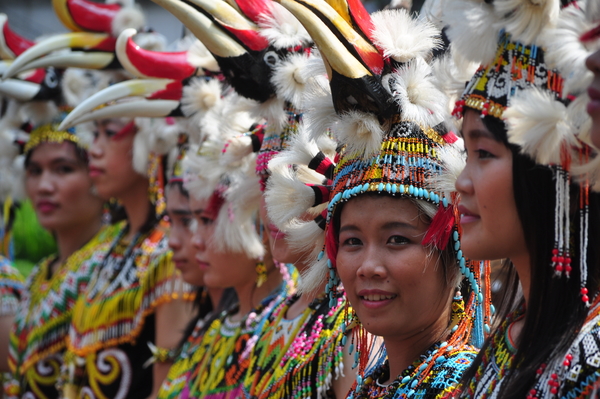
Dayak women at a festival in Jakarta, photo © Dani Daniar via Shutterstock
An emblematic indigenous people of Borneo, the Dayak form one of Indonesia's most well-known ethnic groups. Primarily located in Kalimantan, Dayak country remains one of Indonesia's most interesting destinations.
Known as former head-hunting warrior, they gradually converted to Christianity. However, animist beliefs continue to be deeply rooted in the collective consciousness and local customs.
Dayak culture is very rich and varied. It encompasses traditional dances, pagan rituals, and traditional funeral ceremonies. The local dialect also varies depending on the region. There is so much to discover about it!