Seeing Orangutans
Indonesia continues to fascinate the world with its remarkable wildlife diversity. The archipelago is home to numerous animals found nowhere else, including the legendary Komodo dragons and orangutans
Indonesia continues to fascinate the world with the diversity of its wildlife. The archipelago is home to numerous animals found nowhere else, including the legendary Komodo dragons and orangutans.
Orangutans are remarkable creatures that share nearly 97% of our genes. These animals are currently listed among the world's most endangered species. Many tourists on trips to Indonesia plan their itineraries specifically to encounter these great apes of Asia. If you too wish to meet them, here are some valuable insights to help you organize your stay among the orangutans.
Orangutans at a glance
Great apes facing extinction, orangutans share 97% similarity with the human genome. This is precisely why Malaysians named them orang hutan, which literally means "man of the forest" or "man of the woods".
Key characteristics
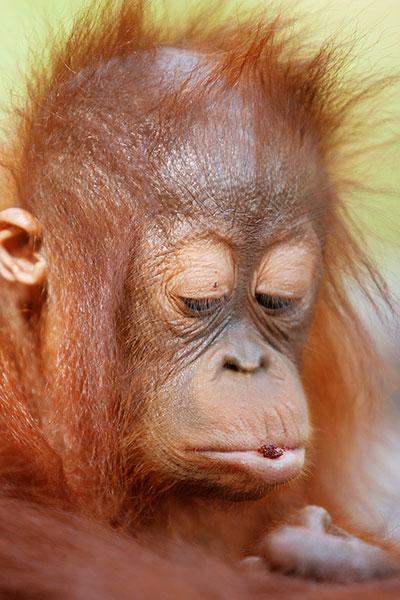
The average height of an orangutan ranges between 1.1 and 1.4 meters, weighing 40 to 90 kg. Their powerful arms are longer than their legs and can reach 2 meters in length. Their life expectancy can reach 30 to 40 years. Young orangutans cling to their mother's back or belly for movement until around age 2 or even longer. Adults spend most of their lives in the trees and avoid the ground where they are more vulnerable to predators.
These primates are known for their exceptional intelligence. Indeed, in the mid-1990s, scientists observed families using tools to feed themselves.
Diet
Orangutans are arboreal great apes. To survive, they feed primarily on fruits, young shoots and bark. They are also keen on small vertebrates, insects and bird eggs. To the astonishment of specialists, some orangutans that previously lived in captivity before being released in Borneo even eat fish products.
Orangutans: a species in danger
Orangutans were once widely distributed throughout Southeast Asia, ranging even to southern China and the southern island of Java. Today, orangutans appear on the IUCN Red List and their presence is limited to two islands, Borneo and Sumatra, from which the names of the two species are derived: Pongo abelii (Sumatran orangutans) and Pongo pygmaeus (Bornean orangutans).
Their population has declined dramatically over the past 80 years. This demographic decline is primarily caused by deforestation, which destroys the natural habitat of these primates. Added to this is poaching, with young orangutans being captured for sale on the black market.
Where to see orangutans in Indonesia?
Today, you will only see orangutans in Malaysia and Indonesia, and more specifically on the islands of Borneo and Sumatra.
On the Indonesian archipelago, you can observe these primates in the Mount Leuser National Park, at Bukit Lawang in northern Sumatra, and in the Tanjung Puting National Park, in Kalimantan in the Indonesian part of Borneo. The Kutai National Park, also located in Kalimantan, is home to some as well.
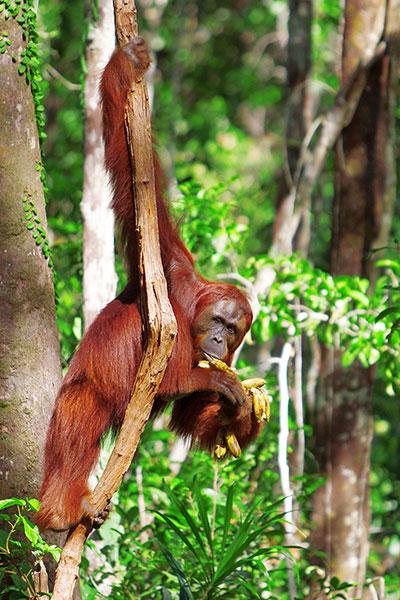
Each of these nature reserves has a rehabilitation center where rangers and specialists care for orangutans. Contrary to what one might think, these great primates are not held in captivity at these sites. They are free to move about according to their needs.
To observe them, you will trek deep into the jungle, accompanied by a certified guide. During the trek, you will observe numerous animal and insect species and encounter some of these great red men of the forest. Sometimes alone or with their young, every encounter is unique and unforgettable.
Which national park to choose?
All the sites mentioned above are open to the public to encounter orangutans.
Mount Leuser Park proves to be the most popular. It is easier to observe Sumatran orangutans (Pongo abelii) at the Bukit Lawang rehabilitation center. This domain, covering 9,500 km², is classified as a "biosphere reserve" and "Tropical Rainforests of Sumatra World Heritage Site" by UNESCO.
With our Mysterious Sumatra tour, we will guide you in the footsteps of orangutans.
When is the best time to see orangutans in Indonesia?
If you wish to see orangutans on the island of Sumatra, plan your stay during the dry season, between May and September. Rainfall is intermittent throughout this period.
Would you prefer to visit the Indonesian part of Borneo to observe Pongo Pygmaeus? Travel between June and October. The climate is pleasant throughout the territory during this period; however, occasional light rains are likely.
My backpack for trekking to discover orangutans
Before heading out to discover Indonesia's orangutans, pack your bags carefully. The trek can be challenging and wet. It is essential to prepare your backpack well so you don't forget anything and can hike in the best conditions.
In my luggage I don't forget:
- Loose and lightweight clothing to handle the heat
- A raincoat or rain jacket to protect yourself from rain
- Comfortable and quality hiking shoes
- A waterproof backpack to carry electronic equipment (camera, phone)
- A water bottle or small thermos to have drinking water at all times
- A first aid kit for any accidents, etc.
- Mosquito repellent