Tangkoko Batuangus Nature Reserve
Tangkoko Batuangus Nature Reserve
Less than two hours from Manado, Tangkoko Batuangus Reserve protects black macaques, spectral tarsiers, and 8,700 hectares of pristine rainforest in Sulawesi.
Located in the northeastern tip of Sulawesi, less than two hours from Manado, Tangkoko Batuangus Nature Reserve protects one of the richest ecosystems in the Indonesian archipelago. Spanning 8,700 hectares (including the adjacent Bukitputih park), it is home to 127 mammal species, 233 bird species, and 104 reptile and amphibian species, several of which are endemic to Sulawesi.
Why visit Tangkoko Batuangus
Tangkoko remains a lesser-known destination compared to Bali or Komodo, making it a privileged site for observing Sulawesi's endemic wildlife in still-pristine conditions. The black crested macaque (Macaca nigra) is particularly visible here, as is the spectral tarsier, one of the world's smallest primates. Add to this a mosaic of landscapes—primary forest, black sand beaches, mangrove swamps, coral gardens, volcanic foothills—concentrated within a relatively compact perimeter.
History of the reserve
Tangkoko's primary forest has been documented since the 19th century. In 1861, British naturalist Alfred Russel Wallace collected specimens of babirusa and maleo megapode, an emblematic bird of the region. At that time, these birds nested in large numbers on Tangkoko's black sand beach. The practice ended in 1915 as a direct result of intensive hunting.
In 1919, the Dutch colonial government of the East Indies designated the site as a protected forest. The creation of the Duasudara Nature Reserve in 1978 extended the area, before both entities merged in 1981 under the current name of Tangkoko Batuangus Nature Reserve.
Current management involves several Indonesian and international organizations—Sulut Bosami, Wildlife Conservation Society, Tarantula—working to protect biodiversity and raise awareness among local communities. Pressure on wildlife remains real: between 1978 and 1993, black macaque populations declined by 75%, maleo populations by 90%, and Sulawesi crested cuscus populations by 95%. A 2005 study in neighboring villages showed that hunting, primarily targeting rats, still affected macaques and cuscuses, both for meat and illegal trade.
What to see in the reserve
The black crested macaque
The Macaca nigra is the site's main attraction. These primates, recognizable by their entirely black coat and frontal crest, live in matriarchal groups of 30 to 100 individuals. Sightings are more frequent early morning and late afternoon, when groups move about and forage.
The spectral tarsier
The spectral tarsier (Tarsius tarsier) ranks among the world's smallest primates, measuring 10 to 15 cm without its tail. Strictly nocturnal, it hides during the day in strangler figs and emerges at dusk. An evening sortie with a local guide significantly increases observation chances: the tarsier's eyes reflect torchlight.
Trails and landscapes
- Coastal trail: an easy route along beaches of black volcanic sand.
- Batuangus cove: coral gardens accessible by snorkeling, and adjacent mangrove forest where herons, egrets, and sea eagles can be spotted.
- Batuangus Peak (450 m): a one-hour ascent offering panoramic views of Lembeh Strait.
- 5 km loop over the foothills of Mount Tangkoko, traversing forest inhabited by macaques, Sulawesi crested cuscuses, and hornbills. The slopes above Remesun beach are one of the few remaining places where maleo megapodes can be observed.
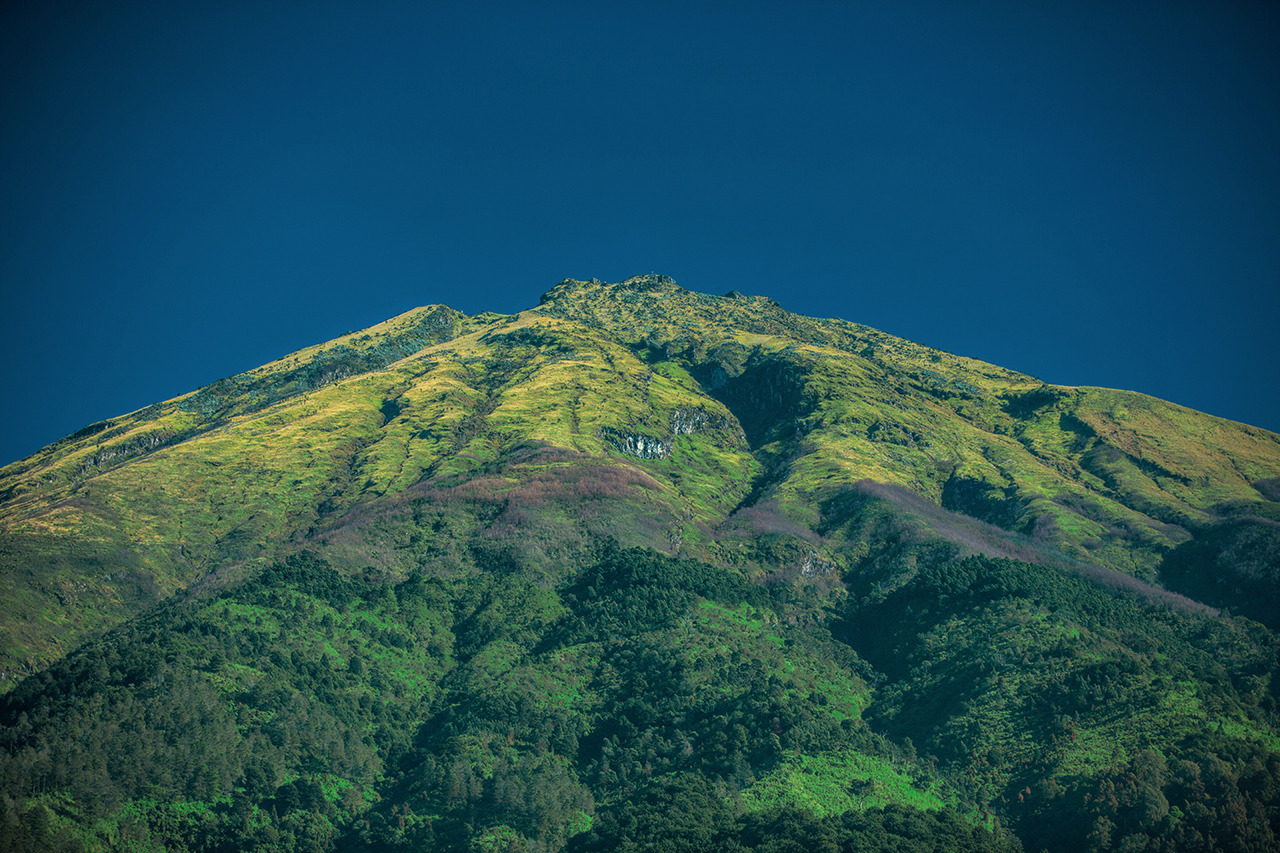
- Mount Tangkoko (1,109 m): a more demanding summit offering views from the crater rim over Lembeh Strait and the city of Bitung.
- Mount Dua Saudara: twin peaks and the reserve's highest point. With poorly maintained trails, a local guide is essential.
When to visit
The dry season, from June to September or early October, remains the most favorable period. Trails are passable, wildlife observation is easier, and evening outings are more comfortable. The wet season (October to April/May) makes paths slippery and some secondary trails impassable.
Practical information
- Guide: a local guide is required to enter the reserve. They facilitate access to observation areas and ensure compliance with wildlife distance regulations.
- Visit duration: plan half a day for a macaque-focused outing, a full day to combine daytime wildlife and tarsiers at dusk, two to three days to include mountain hikes and beach time.
- Equipment: closed-toe hiking shoes, long clothing (mosquitoes), insect repellent, headlamp for evening outings, water bottle, binoculars.
- Fee: modest entrance fee, payable at the entrance, plus guide remuneration.
How to get there
The reserve is located 70 km from Manado, about two hours by road, and 20 km from Bitung. Since buses to Batuputih run irregularly, the easiest option is a private car (with or without driver) or motorbike. Several Manado agencies offer transfers combined with an overnight stay.
Nearby attractions
- Bitung: industrial port 20 km away, departure point for Lembeh Strait.
- Lembeh Strait: premier muck-diving destination, renowned for rare macro species.
- Manado: provincial capital of North Sulawesi, near Bunaken Marine Park.
- Batuputih Bawah: village adjacent to the reserve, where guesthouses and family lodges are concentrated.
Frequently asked questions
Frequently asked questions
Yes, accompaniment by an authorized local guide is mandatory. Beyond regulations, their knowledge of macaque and tarsier habitats greatly influences the quality of observations.
Black macaques are very frequently observed on morning or late afternoon outings. Tarsiers, nocturnal and discreet, are seen at dusk near their roost trees: chances are good but never guaranteed.
Half a day is sufficient for a macaque-focused visit. Plan a full day including evening tarsier outings, and two to three days to add Mount Tangkoko or Dua Saudara hikes.
The spectral tarsier ranks among the world's smallest primates, but Madame Berthe's mouse lemur (Madagascar) is generally considered the smallest. This does not diminish the rarity of observing one at Tangkoko.
The village of Batuputih Bawah, at the reserve's entrance, has several guesthouses and lodges. Bitung, 20 km away, offers a wider hotel selection.
Plan your journey
Tangkoko fits naturally into a northern Sulawesi circuit, complementing Bunaken Marine Park and Lembeh Strait. To structure your itinerary and combine wildlife observation, diving, and hiking, consult our suggestions for travel in Indonesia.
Interested in this visit?
We can include it in your personalised itinerary.