The Peak of the Non-Aligned Movement
The Peak of the Non-Aligned Movement
In the heart of Bandung, the Gedung Merdeka preserves the memory of the 1955 Afro-Asian Conference, a founding event of the Non-Aligned Movement.
From April 18 to 24, 1955, the city of Bandung, on the island of Java, hosted a diplomatic meeting that marked the history of decolonization: the Afro-Asian Conference. Twenty-nine nations, representing more than a billion people, gathered to assert a common voice between the Cold War blocs. Today, the building that hosted these debates, the Gedung Merdeka, houses the Afro-Asian Conference Museum (Asia-Africa Conference Museum), a public heritage site in the heart of Bandung.
Why Visit This Heritage Site
The Gedung Merdeka is not merely a conference hall: it is the stage where the birth of a third diplomatic path unfolded, halfway between Washington and Moscow. The visit appeals to travelers curious about contemporary history, geopolitics, and the emergence of the Global South. It is also an opportunity to understand why Bandung holds a special place in Indonesia's national narrative, beyond its temperate climate and volcanic landscapes.
The museum, located in the city center, is best visited as part of a discovery of Bandung's Art Deco colonial architecture, of which the Gedung Merdeka is itself a notable example.
The History of the Bandung Conference
An Afro-Asian Initiative Prepared in Advance
The idea of a gathering among recently independent nations took shape at the Colombo Group meeting in April 1954, which brought together India, Pakistan, Burma, Ceylon (present-day Sri Lanka), and Indonesia. A second preparatory meeting was held in Bogor, Indonesia, in December 1954, to define the agenda and guest list.
The conference itself took place from April 18 to 24, 1955, hosted by Indonesian President Soekarno. Twenty-nine countries were present: 23 from Asia and 6 from Africa. Among notable figures were Jawaharlal Nehru for India, Gamal Abdel Nasser for Egypt, Zhou Enlai for the People's Republic of China, and Mohammad Ali Bogra for Pakistan. Nicknamed the "Afro-Asian Yalta," the meeting was closely followed by Western chancelleries: according to sources from the time, the United States was providing economic and military aid to 20 of the 29 nations represented.
Topics Debated
Discussions focused on burning issues: the Indochina War, the Palestinian question, the struggle against apartheid in South Africa, tensions in North Africa, the status of Taiwan, and that of West New Guinea. Beyond specific dossiers, delegations sought a common position in the face of East-West polarization.
The 10 Principles of Bandung
The conference adopted a founding text: the 10 Principles of Bandung, inspired by the 5 Principles of Panchsheel formulated in 1954 by Nehru and Zhou Enlai. These principles notably established:
- Respect for fundamental rights and the right of peoples to self-determination;
- National sovereignty and non-interference;
- Equality among all nations and races;
- Peaceful settlement of conflicts and rejection of military alliances serving the interests of great powers.
Six years later, in 1961, the Belgrade Conference gave rise to the Non-Aligned Movement, a direct heir to the spirit of Bandung. More recently, this same spirit has been regularly cited as a source of inspiration for the BRICS.
What to See at the Afro-Asian Conference Museum
The Asia-Africa Conference Museum is located inside the Gedung Merdeka on Jalan Asia Afrika. The visit is organized around several spaces:
- The plenary hall preserved in its original state, with the tables and chairs used by the delegations in 1955.
- The photographic gallery, which traces the arrival of heads of state, working sessions, and the opening ceremony.
- Original archives and documents: communiqués, maps, diplomatic correspondence, copies of the 10 Principles.
- A section dedicated to the Non-Aligned Movement and its evolution through contemporary issues.
Signage is in Indonesian and English. Plan approximately 1 to 1.5 hours for a careful visit, longer if you read the archival documents in detail.
Practical Information
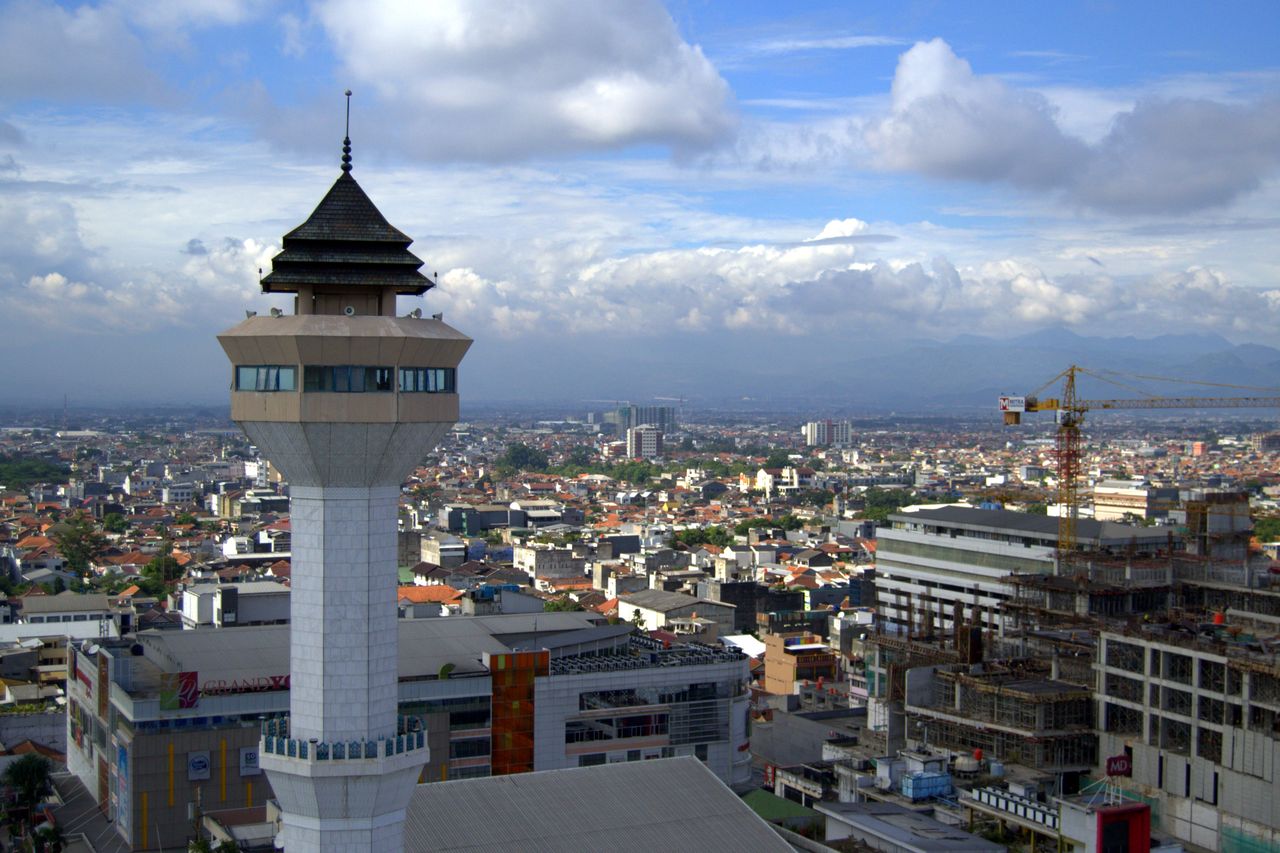
The museum is located in central Bandung, near the alun-alun (central square) and the great mosque. Entry is usually free or at a nominal fee, with identity check at reception. The museum is open Tuesday to Sunday, closed Mondays and national holidays; it is best to check current opening hours before your visit, as these may change.
Proper attire is recommended. Photography is generally permitted in exhibition spaces, without flash.
How to Get to Bandung
Bandung is located approximately 150 km southeast of Jakarta, at an altitude of around 750 meters, giving it a cooler climate than the capital.
- By train from Jakarta (Gambir): direct service to Bandung station, approximately 3 hours travel time. This is the most comfortable and most frequent option.
- By car or minibus via the Cipularang Expressway: between 2.5 and 4 hours depending on traffic, often heavy on weekends.
- By plane: Husein Sastranegara International Airport serves Bandung, but the number of flights from Jakarta remains limited compared to the train.
Once there, the historic center can be explored on foot, by taxi, or via local ride-hailing apps.
Combine With Your Visit
Bandung and its region offer several complementary sites to extend your stay:
- A day in Bandung and its Art Deco architecture, cafés, and markets;
- An excursion to Mount Galunggung, east of the city, for an immersion in Java's volcanic landscapes;
- A discovery of Balinese dances if your itinerary extends to Bali;
- A stop at the Bali Botanical Garden for tropical botany enthusiasts.
Preparing Your Trip
The Afro-Asian Conference Museum naturally fits into a Java-Bali circuit, complementing volcanic sites, temples, and historic cities. To build a custom itinerary including Bandung and its surroundings, consult our suggestions for traveling in Indonesia.
Interested in this visit?
We can include it in your personalised itinerary.