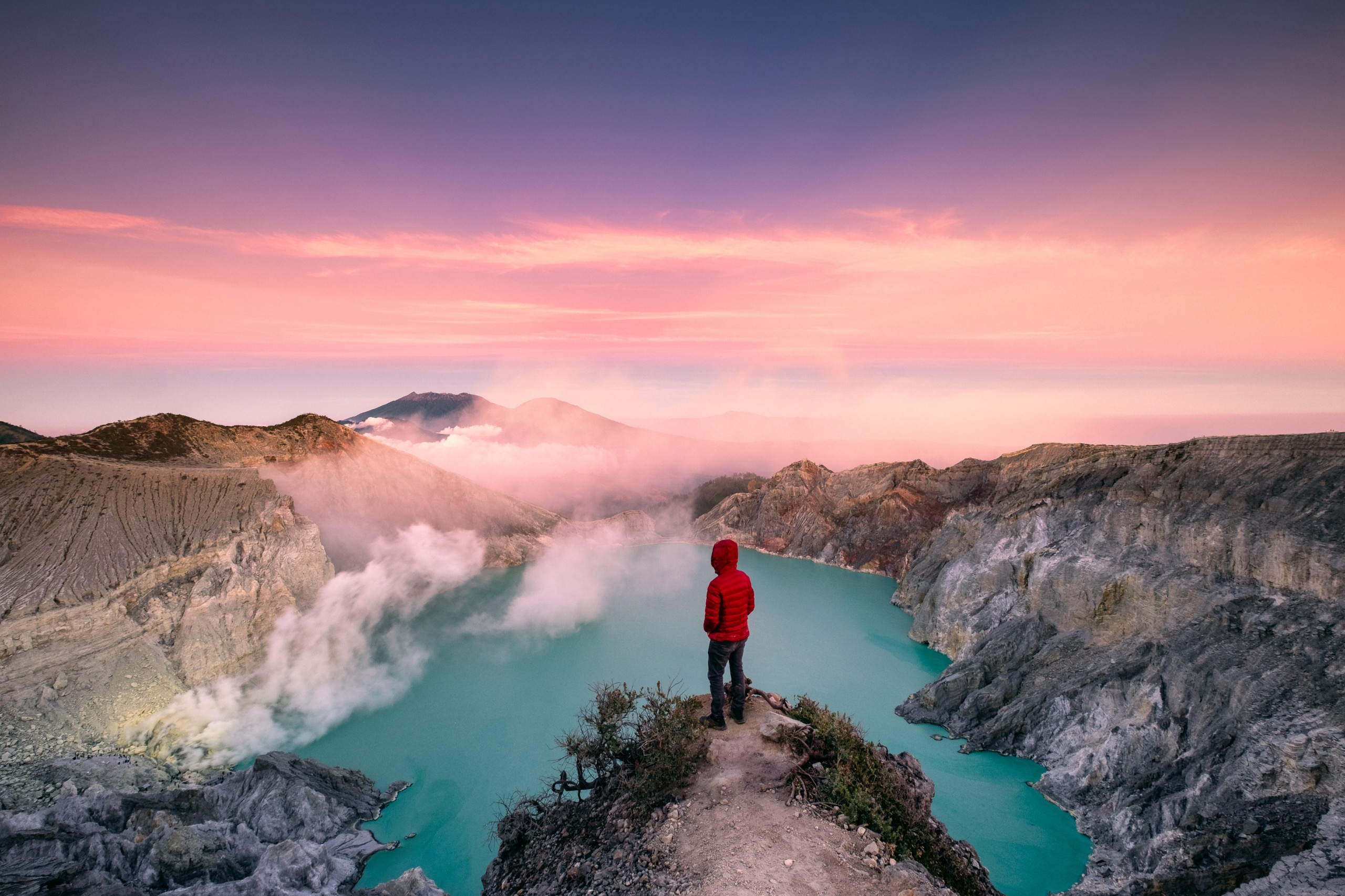
Eruption of Mount Slamet
Mount Slamet, a stratovolcano, is the second-highest volcano on Java and one of the most active. Gas almost constantly permeates the broad summit, which comprises four craters. Explorer Francis Drake spotted the volcano during his first circumnavigation of the world while in the Java Sea.
March 21, 2014 — Mount Slamet, a stratovolcano, is the second-highest volcano on Java and one of the most active. Gas almost constantly permeates the broad summit, which comprises four craters. The explorer Francis Drake glimpsed the volcano during his first voyage around the world while sailing in the Java Sea. He immediately steered his vessel toward the island's southern coast, as if the mountain held some magnetic pull on him. Considered one of Java's most remote locations, the vast lava fields at the summit offer some of the island's most spectacular panoramas—affording views of both the southern and northern coasts.
Local authorities closed Mt Slamet to hikers beginning Monday, March 10, 2014, due to increased volcanic activity. This unusual activity emerged following a considerable series of earthquakes in the region, which escalated from around 50 to approximately 200 per day. The first explosion occurred Monday evening at 8:06 p.m. Shortly after, the Center for Volcanology and Geological Hazard Mitigation (PVMBG) elevated the status from normal to alert (level 2 on a 1-to-4 scale), with a danger zone assessed at 2 kilometers around the volcano. Subsequently, the Central Java Disaster Mitigation Agency (BPBD) prepared evacuation routes and shuttle services in response to the volcanic activity.
"Gunung Slamet" literally means "the safe mountain." "Slamet" is a Javanese variant of the Malay/Indonesian word "selamat," meaning "saved from danger." In the region around Mount Slamet, local tradition holds that in pre-Islamic times, the volcano was called "Gunung Gora." In Javanese, "gora" is a somewhat archaic word meaning horrible, frightening, intimidating. It is quite likely that when the region's inhabitants converted to Islam—probably around the 1500s—the forbidden name inherited from the Hindu-Buddhist period was changed to the more reassuring Islamic name "Gunung Slamet." The volcano sits almost in the middle of the island, roughly halfway between the southern and northern coasts. A myth recounts that an eruption of Mount Slamet would "split" the island of Java into two parts. While mythological, the outcome would be catastrophic! The island's eastern and western tectonic plates would fracture. A large north-south fissure would open, allowing water to rush in. Java would then become two islands. According to the account of Abraham Mudito.
Charlène Nomadays — An SEO writer from Nomadays' earliest days, Charlène evolved into content manager and head of communications, accompanying the adventure with steadfast passion from the beginning. After living seven years across Asia—from China to Thailand, passing through Mongolia and South Korea—she has made travel a way of being in the world. A lover of words, nature, and human connection, she strives to convey in her writing a thoughtful, engaged, and responsible vision of tourism. For her, each article is a bridge between curiosity, respect, and wonder.