Indonesian Ikat
In Indonesia, the art of textiles is among the richest and most developed in the world, and ikat remains one of the most delicate and labor-intensive traditional techniques of the archipelago.
In Indonésie, textile art is among the richest and most developed in the world, and ikat remains one of the most delicate and labor-intensive traditional techniques of the archipelago. Like batik, ikat holds a prominent place in Indonesian culture.
History of ikat
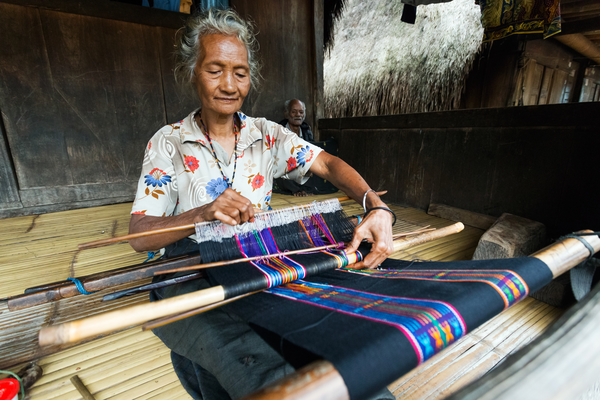
Elderly woman weaving ikat in Bajawa, on the island of Flores, photo © Tony Prince via Shutterstock
The ikat technique is believed to originate from China and was disseminated throughout the rest of Asia with the development of maritime trade in the region. Indeed, the term "ikat" comes from Indonesian and means "to tie, to bind".
This artisanal practice can be found in Central and Latin America, Majorca, Uzbekistan, and other Asian countries. In Indonésie, the Lesser Sunda Islands are highly renowned for their traditional ikat production. This form of craftsmanship is also found in Java and Sumatra.
Like batik, ikat remains a social symbol and was used to establish the social class to which an individual belonged. Some peoples still consider ikats as an essential part of young women's dowries.
The ikat technique
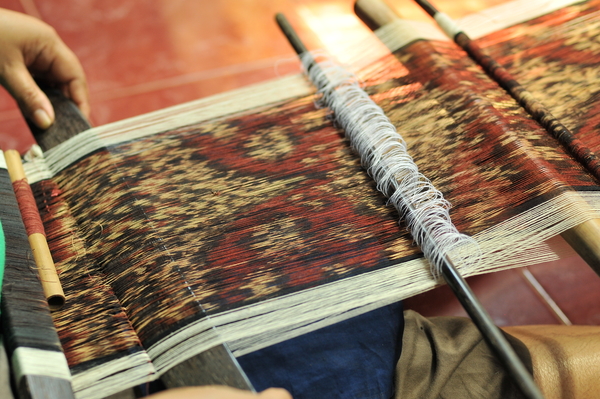
Ikat production in Bali, photo © Yuki Takahashi via Shutterstock
To create their patterned textiles, weavers first draw the design by dyeing the weft thread beforehand. They thus bring out all the colors featured in the model, repeating the operation as many times as there are colors. Furthermore, they protect the parts to be preserved from dyeing by tying threads on the areas to be retained. These designs then form during the weaving process.
Weaving is done on a loom, and the fibers used vary depending on the region. These may include silk, cotton, or wool. The edges of the patterns remain blurred, particularly due to shifts that occur during production. The difficulty therefore lies in the precision required for proper alignment of threads and colors.
As one might expect, this is long and laborious work, which can take several months. Indonesian ikats were thus precious commodities, once exported by Dutch colonists. The most renowned originate from the island of Sumba. The hinggi ikats from this island display vibrant colors with motifs featuring animals and human figures. Similarly, you will not find the same ikats in Bali as in East Timor.
Generally, patterns vary by region. Certain variations in technique may also appear. Some peoples add gold threads, for example.
No matter where you find yourself in Indonésie, we highly recommend taking time to admire this art form. If you travel through the Lesser Sunda Islands, visit the small traditional villages for the chance to witness textile production. Ikat is well worth your attention!