Buddhist and Hindu Heritage of Indonésie
Indonésie is renowned for its rich and refined history and culture. The Indonesian archipelago, a maritime crossroads between Europe and Asia, experienced numerous foreign and ethnic influences, each contributing to create present-day Indonésie. The country's ancient Buddhist and Hindu influence can still be found on certain islands.
Indonésie is renowned for its rich and refined history and culture. The Indonesian archipelago, a maritime crossroads between Europe and Asia, experienced numerous foreign and ethnic influences, each contributing to create present-day Indonésie. On certain islands, you can still find traces of the country's ancient Buddhist and Hindu influence. Between ancient temples, cultural and artistic heritage, Indonésie continues to captivate us.
The Classical Period
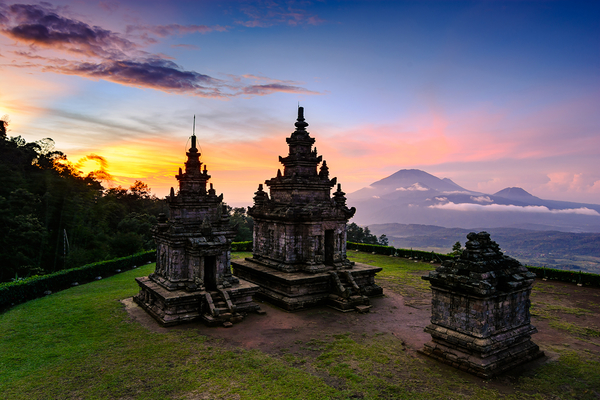
Gedong Songo Temples
Many historians use the term "classical" to describe the Indonesian Hindu-Buddhist period spanning from the 5th to the 15th century A.D. Vestiges of a past blending Hindu and Buddhist worship can be found on Java and Sumatra.
For example, in the 8th century, two famous dynasties shared control of the Central Java region. After the Hindu Sanjaya dynasty was displaced, the Sailendra, who were Buddhist, took control of the kingdom. They were notably responsible for the famous Borobudur temples. The Sanjaya became vassals to the first family and, for their part, built Hindu temples such as those on Mount Gunung Ungaran or on the Dieng plateau. The Sanjaya dynasty eventually regained power a few decades later and constructed Prambanan to celebrate their victory.
In the 11th century, the Kediri empire became one of the most prosperous on Java. It was from this period that the Javanese dominated South Asian maritime trade, becoming masters of shipbuilding and navigation throughout the peninsula. Indian culture, particularly its famous epics, contributed to the flourishing of literature on Java.
Many kingdoms and principalities existed on Sumatra and Java. One of the most renowned is surely Majapahit, which reached its zenith in the 14th century under the celebrated King Hayam Wuruk. During his reign, tolerance toward both religions was emphasized.
By the end of the 15th century, the last Hindu kingdoms of Majapahit and Kediri fell under Muslim domination from Sumatra and northern Java. The last Hindu nobles therefore took refuge in Bali.
The Hindu-Buddhist Heritage of Indonésie Today

View of the Pura Besaki temples, Bali
The Hindu-Buddhist empires left their mark on Indonesian history. Their influence can still be seen through the presence of temples that remain standing. Javanese culture and art have long been influenced by the Indian epics of the Ramayana and the Mahabarata. This influence is particularly evident in the traditional dance and theater performances of central Java. The ancient kingdoms of Yogyakarta and Surakarta are home to the island's most renowned dance schools.
The majority of Hindus in Indonésie now reside on Bali. On the Island of the Gods, ceremonies, offerings, and prayers punctuate the daily life of the population.
Today, Hinduism and Buddhism are two of the official religions of the Indonesian archipelago. Indonesians are conscious of their historical heritage and wish to preserve it. Indeed, the country's motto is "Bhinneka Tunggal Ika," which translates to "unity in diversity." It is drawn from the poem Sutasoma, written during the reign of Hayam Wuruk. This is beautiful proof that Indonésie is still a country where multiple religions and cultures can coexist!