The Dutch Colonial Era
The natural riches of the Indonesian archipelago are no secret to anyone. They were no secret to the Dutch in the 16th century either. Throughout its history, Indonesia was coveted
The natural riches of the Indonesian archipelago are no secret to anyone. They were no secret to the Dutch in the 16th century either. Throughout its history, Indonesia was coveted by many European powers for its spices. Nutmeg, cinnamon, coffee, cane sugar, pepper, clove, vanilla—these were then the objects of desire for the old continent. Many foreign presences, notably English and Portuguese, occupied the Indonesian islands for long periods, regularly giving rise to conflicts and local wars for territorial control.
The Arrival of the Dutch and Gradual Creation of a Colony
In 1602, the Dutch government created the VOC (Vereenigde Oost-Indische Compagnie) and granted it numerous powers, including the right to wage war in Asia on behalf of Holland. Batavia, formerly Jayakarta, present-day Jakarta, eventually became the headquarters of the VOC. The company ultimately drove the Portuguese out of Ambon and took control of the Moluccas.
From this point on, there was a massive departure of Dutch merchants bound for Indonesia. After the construction of the Suez Canal at the end of the 19th century, Dutch emigration intensified.
Thus, Holland gradually annexed the Indonesian territories, eventually gaining complete control over much of the archipelago. The kingdom instituted forced cultivation in 1830 to meet the needs of its population in Europe. Indonesia became a full-fledged colony from that point forward.
Living Conditions of Indigenous Peoples Under Dutch Rule
During this Dutch grip, numerous rebellions and revolutions led by Indonesians were repressed. Often violently and in bloodshed. The Dutch did not hesitate to massacre indigenous peoples to maintain their domination.
Thus, in order to maintain some semblance of order, they allied themselves with the Javanese nobility. The goal remained to find common ground and benefit from the loyalty that the people held toward their sovereigns.
In the early 20th century, numerous Islamist and socialist movements emerged within the colony. They were primarily driven by Indonesian intellectuals educated by the Dutch government. By 1940, nearly 30,000 Dutch officials were administering the archipelago and approximately 90% of the local population remained illiterate.
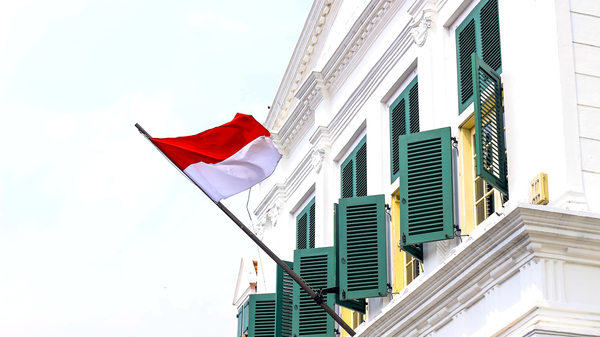
Indonesian flag waving in the wind
Japanese Domination and Indonesia's Liberation
In 1941, the Pacific War engulfed Southeast Asia. In 1942, shortly after the attack on Pearl Harbor, the Japanese army invaded Indonesia, imprisoning the Dutch forces and seizing control of the archipelago.
The violence and looting inflicted by the Japanese on the Indonesian population marked this turbulent era. After Japan's defeat, Indonesia erupted again, and a war for the country's final independence began. The Revolusi would last four years.
Furthermore, Holland used money loaned under the Marshall Plan to conduct this campaign on the archipelago. However, faced with pressure from the United States and international public opinion, it eventually withdrew from the conflict.
Finally, in December 1949, Soekarno, elected president, proclaimed the establishment of the Indonesian Republic government. It would officially assume office on August 17, 1950.