Indian Epics
Indonésie is a country with a strong Muslim majority, the largest in the world in terms of number of believers. Yet today, it is still possible to see the influence that Hinduism and B
Indonésie is a country with a strong Muslim majority, the largest in the world in terms of number of believers. Yet today, it is still possible to see the influence that Hinduism and Buddhism have had on much of the archipelago. The artistic and cultural heritage of these two historical periods is immense. A closer look at the epics that shaped Indonesian culture!
Râmâyana and Mahâbhârata, legendary poems from India
It is these two fundamental texts of Hindu religion and mythology that immediately come to mind: the Râmâyana and the Mahâbhârata. It is impossible to gain a complete understanding of Indonesian art without referring to these two famous Indian epics.
The first has its origins between the 3rd century BCE and the 3rd century CE. It is an epic poem consisting of seven books that tells the legend of Prince Rama. The seventh avatar of the god Vishnu, he is subjected to trials throughout his life. The Râmâyana recounts his adventures and his famous love story with the beautiful Sita. The sage Valmiki is considered the original author of this work.
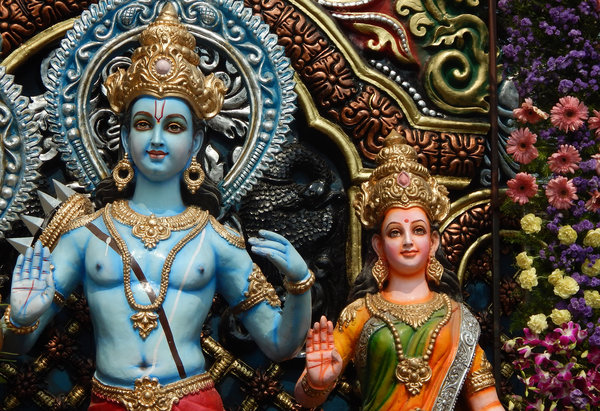
Rama and Sita, photo © hyderabad India via Shutterstock
The Mahâbhârata was written long after the Râmâyana and tells the story of the Great War of the Bhârata. It is considered the greatest poem ever composed. It indeed highlights the history of the Pandava princes and the conflict that opposed them to their cousins: the Kaurava.
Extremely popular myths in Southeast Asia, they are comparable to Homer's Iliad and Odyssey, or to the narratives of the Quran and the Bible. The gradual expansion of Indian culture in the Asian region greatly contributed to the spread of these two legendary texts.
On the Indonesian archipelago, ancient trade relations with China and India helped spread Hinduism and Buddhism. In fact, mentions can notably be found of the islands of Sumatra and Java in the Râmâyana. The creation and heyday of the Hindu Javanese kingdoms left many archaeological remains, and Prambanan remains one of the most well-known.
Integration of this heritage into Indonesian culture
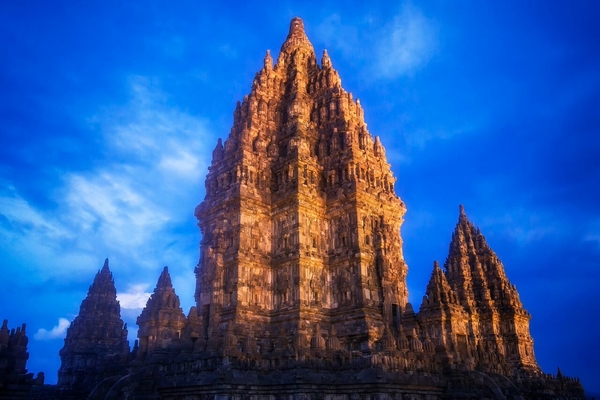
Prambanan Temple, photo © Shutterstock
Since Indian epics are perceived as moral tales, they have long allowed the perpetuation of traditional values. Although Islam holds a predominant place in contemporary Indonesian society, Indonesians still celebrate the worship of ancestors and spirits out of a desire to preserve a part of their Hindu-Buddhist heritage.
The Râmâyana and Mahâbhârata have also inspired many songs and poems throughout Southeast Asia. Many traditional dances thus find their inspiration in these epics. The adaptation experiences changes depending on the regions and countries (Malaysia, Myanmar, Cambodia, Thailand, Laos, etc.). In Indonésie, these legends contributed to enriching traditional theater, particularly the famous shadow puppet theater called wayang.
Indonesian performing arts reached their height at the royal courts of Java and Bali. Thus, dance, music, and theater were among the principal means of transmitting stories linked to Indonésie's historical past.
Even today, you cannot attend a traditional performance without being transported to another era. That of heroes, princes and princesses, demons and Hindu gods.