Suharto's Dictatorship
Despite Indonésie's commitment to non-alignment with Soviet and American blocs, internal turmoil within the country would reshape political decisions. After establishing a system of
Despite Indonésie's commitment to non-alignment with Soviet and American blocs, internal turmoil within the country would reshape political decisions. After establishing a system of "directed" and "guided" democracy, president Soekarno decided to draw closer to the Indonesian Communist Party, the PKI. Yet soon after, the Indonesian economy collapsed and inflation spiralled out of control.
Political Turmoil and the Seizure of Power
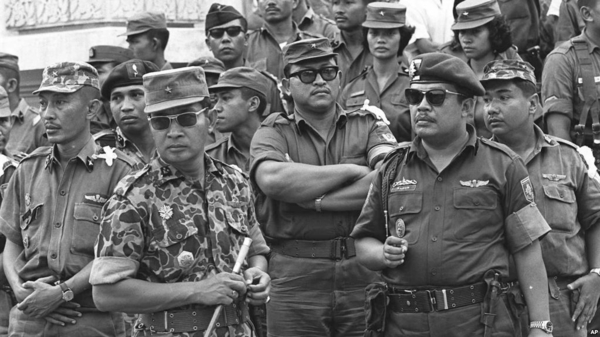
The situation was critical, and Indonésie stood on the brink of collapse. The September 30, 1965 Movement near Jakarta upended the already-fragile order. On the night of September 30 to October 1, six generals from the high command of the Army's ground forces were abducted by a group of rebel soldiers and brutally executed.
Still relatively unknown at the time, Suharto, a general and commander of the strategic reserve, reacted swiftly and took control of the military to quell the insurrection. He dissolved the PKI and banned all communist-related doctrines. He then orchestrated his acquisition of full powers by forcing Soekarno to sign the "Supersemar", a document that granted him authority to assume the presidency. Ousted from power, the former Indonesian leader withdrew from public life and lived under house arrest until his death in 1970.
What followed was a bloody transition into a "New Order". Communist sympathizers, their families, and their associates became targets of a violent and repressive political purge. Led by the Indonesian National Party, the Nahdlatul Ulama Muslim Party, and the armed forces, these massacres also claimed moderate Muslims, Hindus, Christians, and other ethnic and religious minorities such as Indonesian Chinese. The death toll reached approximately 500,000 victims, spanning several months. One million people were deported to camps. This period is regarded as one of the darkest chapters in Indonésie's history.
The Suharto Government
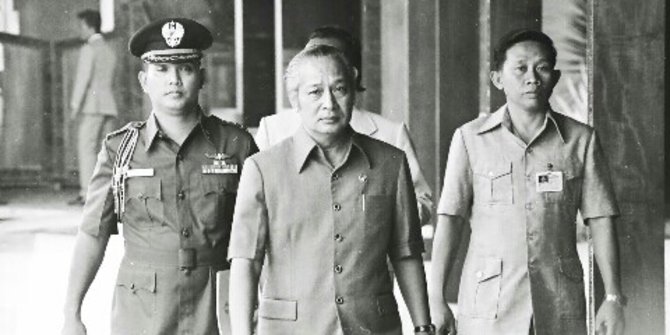
Now firmly entrenched in power, Suharto sought to drive the development of Indonésie, at the expense of political freedoms for the Indonesian people. He restored relations with the United States and major international organizations such as the UN and the IMF. Simultaneously, he severed diplomatic ties with the Soviet bloc and China.
Every five years, the government held a facade of presidential elections from which Suharto invariably emerged victorious. He would remain at the helm of Indonésie for thirty-three years.
During his presidency, the archipelago began to attract foreign capital investment and assert itself economically. Suharto also allowed international oil companies to establish operations on the territory. The revenues generated made it possible to create new administrative, educational, and health infrastructure.
Forced to liberalize its economy in the 1980s, Indonésie experienced a wave of privatizations. Suharto placed these enterprises in the hands of cronies and his children, who amassed considerable wealth. Furthermore, numerous political troubles emerged, particularly in Timor, which Indonésie invaded. The region suffered countless massacres, with an estimated 200,000 victims.
To the detriment of the population, corruption and embezzlement became rampant within the government. Social inequalities widened and general discontent grew.
Finally, the Asian financial crisis that struck in the late 1990s sparked widespread insurrection. Numerous demonstrations and riots erupted across the archipelago. Indonesians demanded Suharto's departure. He eventually resigned from the presidency in 1998, ceding power to his first vice-president B. J. Habibie.
A period of reforms ensued, gradually allowing Indonésie to reconnect with the long-cherished foundations of democracy.