Guided Democracy
Following Indonesia's independence from the Netherlands in 1949, the country experiences a lengthy period of internal restructuring. The establishment of the new Indonesian government is carried out by Soe
Following Indonesia's independence from the Netherlands in 1949, the country experiences a lengthy period of internal restructuring. The establishment of the new Indonesian government is carried by Soekarno. First president of the Republic of Indonesia, he gradually steers his nation toward guided democracy. During this turbulent period in history, the Indonesian archipelago becomes the stage for numerous conflicts of interest with significant geopolitical stakes.
Indonesia's Entry onto the International Stage
Following the end of the Revolusi and the proclamation of independence, the country experiences several insurrectionary movements. Numerous revolts accompany Soekarno's rise to power in certain Indonesian regions such as Sulawesi or Sumatra. Quickly suppressed, they provide the new president with an opportunity to impose order. Certain conflicts extend over time, such as that of the province of Aceh, in northern Sumatra. Eventually, it gains a special status granting it a degree of autonomy from the rest of the country.
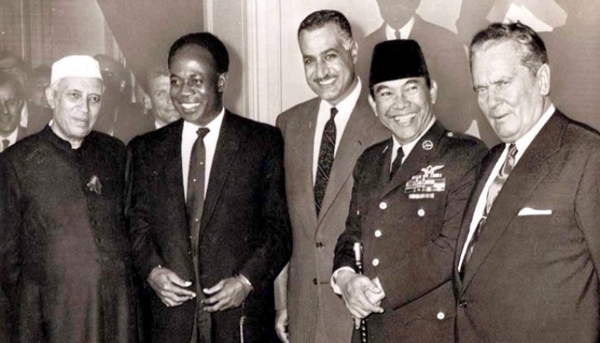
In the midst of the Cold War, Indonesia asserts itself on the international stage by hosting the Bandung Conference (1955) and championing the Non-Aligned Movement. Leaders of Third World countries such as Zhou Enlai, Nehru, and Nasser participate in this gathering. All refuse to align with either of the two blocs dividing the world at that time. The decisions made during this conference accelerate the international decolonization process and bring new nations to the fore against the United States and the Soviet Union.
Confrontations with Neighboring Countries and Diplomatic Relations
However, from the 1960s onward, Indonesia enters into conflict with other nations to preserve its sovereignty over certain regions considered Indonesian. From 1962, the country's relations with Malaysia deteriorate and a tug-of-war ensues between the two states for control of Borneo. The Konfrontasi forces Indonesia to vigorously oppose the British who, according to the government, threaten the country's independence.
This confrontation between Malaysia and the Indonesian archipelago ends in 1966, with the island's division into three distinct parts. One belongs to Indonesia (Kalimantan), a second is under Malaysian government authority, while the small state of Brunei occupies a portion of Borneo.
Furthermore, since independence, the question concerning control of Papua in New Guinea remains unresolved. Indeed, the region remains under Dutch authority and the Indonesian state claims its annexation. The United States resolves the matter in 1962 and ultimately grants Papua to Indonesia.

In parallel, the rise in power of the PKI, the Indonesian Communist Party, pushes Soekarno to align with the Soviet bloc. Indonesia begins to maintain diplomatic relations with other Asian countries aligned with the USSR. Thus, the country draws closer to China, Vietnam, Cambodia, and North Korea.
The United States views this rapprochement with disfavor and fears the emergence of a new conflict in Southeast Asia. However, Suharto's coup d'état in 1965 reverses the situation. Henceforth, the political upheaval Indonesia undergoes forces it to reconsider its international preoccupations. Thus begins a political purge that will usher in thirty-three years of dictatorship.