The dances of Indonesia
It is difficult to speak of Indonesia without thinking of its incredible cultural and artistic wealth. The vast Indonesian archipelago possesses an extensive repertoire of traditional dances unique to each
It is difficult to speak of Indonesia without thinking of its incredible cultural and artistic wealth. The vast Indonesian archipelago possesses an extensive repertoire of traditional dances unique to each ethnic group that comprises it. How could we not reference the magnificent dancers of Java's royal palaces who bring Indian epics back to life? And how could we not be captivated by the beauty of Balinese dances found in many villages on the Island of the Gods? Between modern and traditional Indonesian dances, let yourself be surprised by the diversity this beautiful country offers.
National dances: symbols of Indonesian hegemony
Indonesia is an archipelago with numerous cultural and religious diversities. It is home to more than seven hundred ethnic groups. Each region and people thus possess their own traditional dances. It is therefore impossible to refer to only one particular dance when presenting this vast country. Nevertheless, at the international level, artistic performances often blend various types of dances presented as "Indonesian," thereby marking a brand and belonging to the entire country.
There are, however, two dances considered national: dangdut and poco-poco (pronounced "potcho-potcho"). Both are contemporary Indonesian dances that emerged in the mid-twentieth century. They mark the beginning of the country's modernity and the arrival of popular and rhythmic music.
Dangdut draws heavily from Indian films and music and became popular in the 1960s. Poco-poco originates from the island of Sulawesi. It is danced in lines and columns formed by men and women. They sway their hips and swing their arms while executing the same gestures and movements.
These two dances have little in common with the traditional dances of Indonesia, but they are nonetheless considered important cultural elements.
Traditional dances: between ceremonies, rituals and royal protocols
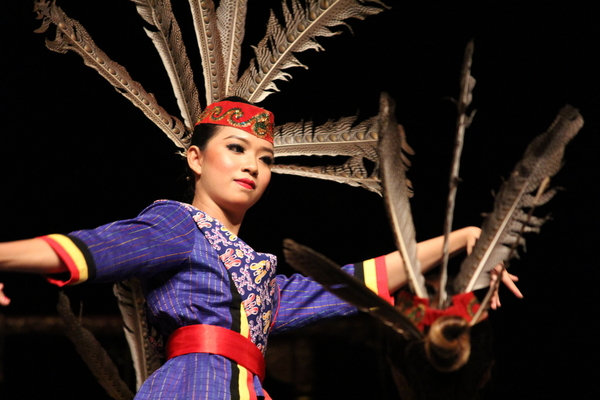
Malap merinu dancer, traditional dance of Kalimantan
The circumstances of traditional dances vary from one region to another in Indonesia. They may be linked to rituals, social and religious ceremonies, or royal palace protocols.
In Sulawesi, inhabitants of the South welcome visitors with a welcoming dance called pakarena. It is performed by young women who accompany their movements with a large fan. In the north, men also dance the kabasaran. Originally, it was a war dance practiced before battles. Today, locals perform it to welcome visitors. The dancers wear headdresses crowned with feathers, red costumes, swords and spears. European influences marked this part of the island very strongly, particularly the traditional dances. For example, inhabitants perform the katrili as a couple, derived from the quadrille and imported by Spanish colonizers.
The Dayak and Malay of Kalimantan also possess many dances specific to their customs. In the region of Aceh, in the north of Sumatra, men practice the saman. On their knees, they play body percussion with their hands and sing in rhythm. UNESCO classifies this dance as an intangible cultural heritage requiring preservation. Also in Palembang, nine young girls dressed in sumptuous golden and colorful costumes welcome travelers with the gending sriwiyaja.
The Hindu and Buddhist heritage of Java and Bali:

Legong dancers, in Bali
The Javanese and Balinese once possessed similar dances. These evolved differently after Java became Muslim, abandoning Hinduism. These dances find their origin in the representation of the Ramayana and the Mahabharata, famous Indian epics. The dancers reproduce the legends and tales of these poems by embodying gods or heroes from Hindu mythology.
On Java, court dance truly developed during the Mataram kingdom era. Several dance schools emerged, particularly in the royal palaces of Yogyakarta and Surakarta. The most well-known royal court dances are bedoyo ketawang and srimpi.
Bedoyo ketawang is a representation of the legendary encounter between Ratu Kidul, the queen of the South Seas, and the king of Mataram, Panembahan Senopati. It is danced by nine young girls. In the past, these dancers were generally of royal blood. Srimpi is danced by four young girls, a number evoking the four elements—water, fire, earth and air. During this period, one also observes the height of the danced theater called wayang wong.
On Bali, legong kraton is the traditional court dance. A representation of the celestial ballet of divine nymphs, it is performed by three little girls. The condong embodies a court attendant and dances solo. The legong, characters of royal blood, then join her on stage. These wear identical costumes and dance in synchronization. On Bali, it is not uncommon to witness a beautiful legong performance.
Traditional Indonesian dances today: a cultural heritage to pass on
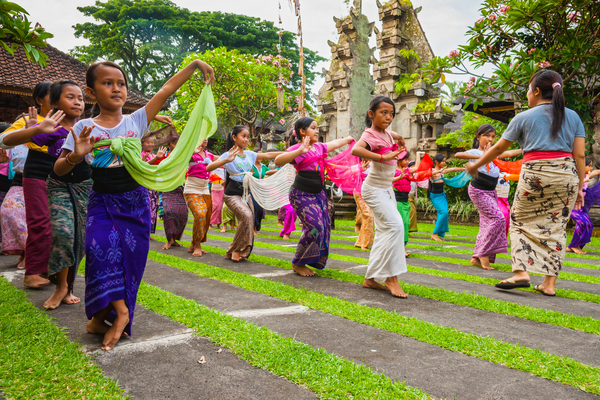
Dance class in Bali
Once, nobles and royal members reserved the learning and presentation of royal court dances for themselves. Since then, a democratization of techniques and artistic practices has been established in villages, thus enabling the transmission of numerous Indonesian dances.
Today, schools of performing arts can be found in almost every major city in Indonesia. Tourism also contributes to revitalizing the discipline, particularly by creating significant demand for performances and representations.
Many contemporary Indonesian artists also wish to help perpetuate traditions, seeking to offer international prominence to Indonesian culture.
If you are passing through Java, note that every year the ballet celebrating the Ramayana takes place. This spectacle runs every evening during the dry season in front of the Prambanan temples. Let yourself be amazed by the beauty of the staging and the grace of the dancers. They are often among the best in Indonesia!
And if you have the chance to witness other dance ceremonies elsewhere in the archipelago, do not hesitate to enjoy the beautiful spectacles that these Indonesians, passionate about their heritage and traditions, will offer you!