Meeting the Papuans in the Baliem Valley
It is possible to be left breathless by a landscape, right there on your doorstep. Whether you live by the sea, on the slopes of a mountain or even in the heart of a megacity
It is possible to be left breathless by a landscape, right there on your doorstep. Whether you live by the sea, on the slopes of a mountain or even in the heart of a megacity. To continue discovering, to experience an adventure where you have settled your bags for many years. This is certainly the beauty of the world, its capacity to deliver and renew wonder in the everyday.
However, this search for the unknown, this sense of escape, can also be provoked deliberately; confronting it head-on by seeking and encountering a radically new world. Certainly, this requires traveling, perhaps taking a plane. The (climatic) consequences induced by this mode of transport are known to all today; thus travel, which paradoxically is a catalyst for encounters and sharing, remains above all a selfish pleasure; in a sense a credit against the world's future. But travel is precisely much more than a displacement; it is also a therapy for all ills and does exemplarity at all levels not lead to life-denying asceticism?
However, that is not our purpose today. In this post, we are therefore talking about travel, and particularly about one journey. One of those whose possibility filled us with wonder when as children we pored over atlases. All the more so because it is an island in the Southern Hemisphere, on the margins of the Indian and Pacific Oceans, and its inhabitants crystallize a powerful imaginary. And then Corto Maltese ventured there in "The Ballad of the Salt Sea", so what better traveling companion?
What is to be found in New Guinea
But let us endeavor to be precise: this is therefore New Guinea. Singularly, men (Europeans…) traced – cut – a border there, dividing the island into two political entities; a geometric legacy of past colonial empires. The West, under Dutch control, was later integrated into the vast Indonesian whole, the East – German and British – became independent under the name of Papua New Guinea.
"One Island, one Country", I remember this graffiti on the walls of Dublin in the last century, it had struck me and seemed to make perfect sense. I imagine this dream of unity is also shared by some in New Guinea, nevertheless, we must be aware of the heterogeneity of this territory. The third largest island on the map, the region concentrates the greatest linguistic diversity in the world: the idioms number in the hundreds. Impenetrable mangroves, deep valleys, high ridgelines, the topography has limited exchanges, allowing entities to live and develop in isolation. Thus a journey to New Guinea consists of accepting a piecemeal vision of the island.
Setting out to conquer the Baliem Valley
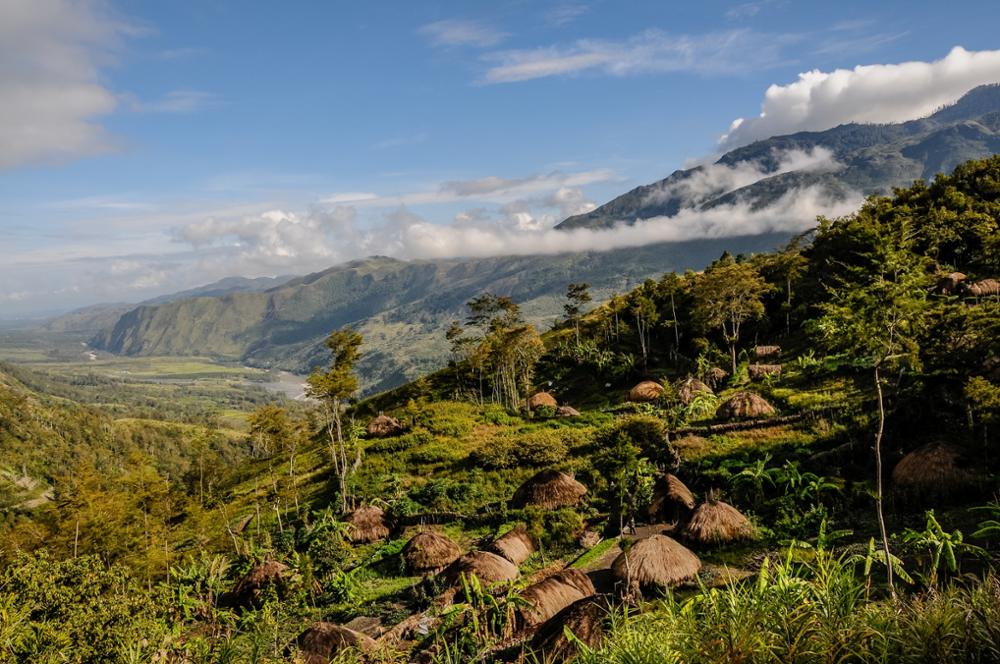
On our part, the choice fell on the Baliem Valley. In the center of the island, on Indonesian territory, it remains relatively easy to access. From Jayapura, the large coastal city and bridgehead of the Indonesian presence (colonization?), it is possible to take an ATR flight to Wamena. Wamena; it is a sort of Far-West town, recent and without History, a convergence point for inhabitants of the high valleys of the Dani ethnic group. Rutted streets laid out at right angles lead to the nerve center of the city, the covered market held there daily. It is a great bazaar where exotic fruits, vegetable produce, Chinese trinkets, Papuan handicrafts and wandering pigs all mingle. The ground is streaked with the red spittle of betel chewers, the carcass of a flayed dog awaits butchering at a meat stall, chickens wander among young people sniffing glue, in the absence of being able to drink alcohol, whose sale is banned from the city.
Wamena, the obligatory passage
Wamena is an economic hub, a point of attraction for Papuans: it defines the dichotomy of this territory that wavers between ancient traditions and modernity, which also aspires to change. It is not for Wamena that we came to Papua, nevertheless, it is a mandatory gateway, an entry point; a paradigm of these emerging countries and changing societies.
The appeal of Wamena thus lies in its airport which allows you to land in the very heart of New Guinea, in a basin surrounded by mountains. A few kilometers in an old jeep and the road ends at a bridge swept away by a flood; a few logs are thrown across and you will have to cross on foot the vast bed of a stream flowing into the Baliem, which, incidentally, leaves one to imagine the power of the water that must cascade down the mountain on certain occasions.
First encounter with the Papuans
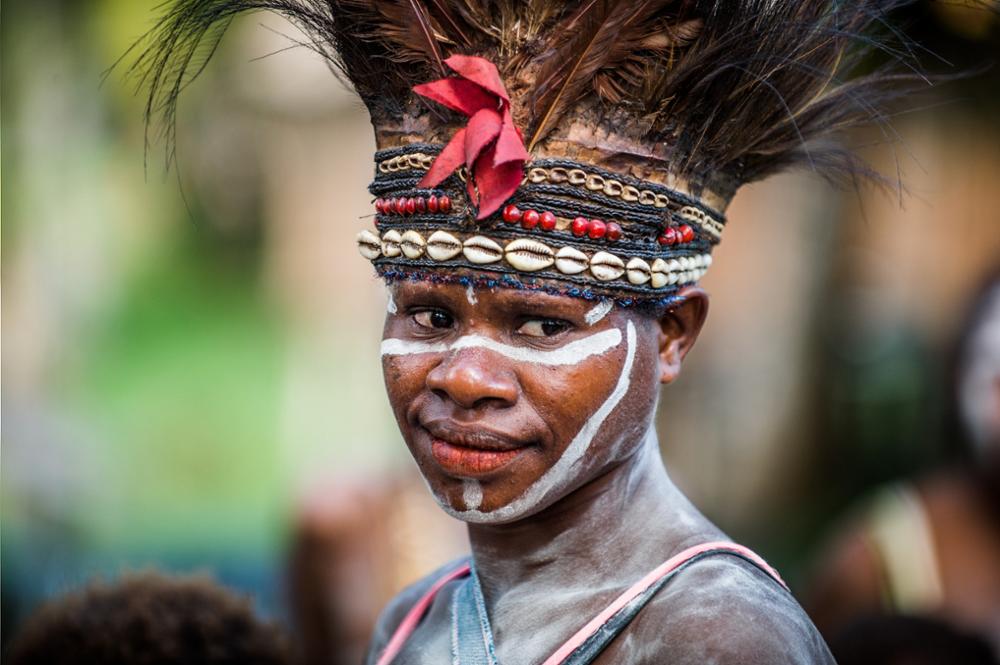
Beyond that bridge, mobile phone networks are no longer accessible, there are no shops, no possibility of restocking bottled water. If the objective is only to make a quick one-day foray into the valley, then you can certainly do without the aid of a guide. However, for several days, it seems essential to us. The guide will master the trails perfectly and know how to adapt them to your abilities, will be the interpreter between you and the Papuans you meet, will have the networks of knowledge to sleep in the villages, will organize the logistics with his cook and porters (provisions, cooking utensils – essential for boiling water – possibly tents). Hiring porters is also a way to provide a source of income for these families. Because you must understand that the Papuans in the villages live outside the economic system as we understand it. In the mountains, they are all farmers and self-sufficient, the land is fertile and generous, it provides what they need to eat, but this system does not provide any monetary return. Thus, buying a piece of handicraft, hiring a team with a guide, will allow locals to earn some money that will be spent in Wamena to buy small objects that improve daily life.
Sometimes it takes little to be happy, and walking in a majestic place contributes greatly to this. The paths that progress along the contour lines have the advantage of limiting elevation changes; you can progress for several kilometers, perpendicular to the slope, before encountering a drop or a steep section. Caressed by the breeze, in a pristine universe where vegetation and mineral are set against a sky of varying hues, the mind wanders without constraint. You cross a ravine and a new perspective opens, revealing a hidden stretch of mountainside where a powerful torrent cascades down.
And then, around a bend in the path, you come face to face with an old Papuan going about his daily tasks. He is naked, just a penis sheath and a crown of feathers; he has not prepared himself to receive tourists; he is simply there, as is his habit, as his father and grandfather before him were, and all his ancestors long before the arrival of the colonists. On the hand he extends to greet us, we observe severed phalanges: cut off by a stone axe, these mutilations accompanied his mourning. We realize then that in a few years, a generation, this will have disappeared. Christian missions, Javanese officials at the forefront, schooling, the presence of tourists, all of this gradually erodes a foundation nonetheless millennia old. Thus goes the march of the world. Nothing will remain then but folklore and one will have to venture deeper into the island, into still unexplored lands, board a Pilatus plane to land on a short runway of a high plateau.
In any case, today, the mountain remains still populated and the valley offers much to see with numerous villages scattered on these flanks. When you approach one of them, you notice that the mountain is entirely shaped. Upstream and downstream of the village, there extend carefully delimited plots separated by dry stone walls; some constitute pig pens (whose possession confers power and wealth), others display perfectly aligned rows of vegetables. Here and there, you observe retaining walls, staggered terraces; for generations, the land has been worked, modeled. Almost everywhere, you now find a small evangelical mission church, however, before these modern markers, it must have been difficult to spot the villages on the mountain flanks. Dani housing is made of small circular vegetable huts. You enter through a small door that almost requires crawling. The hut is divided into two levels, but the confined space does not allow you to stand up straight, you must crouch. Upstairs is the sleeping area, accessed by a small ladder. On the ground floor and in the center, there is always a hearth. As there is no chimney, everything is covered in soot, and the ceiling and walls have taken on a black hue; the absence of a window also imparts a strange feeling. The living space is symbolically charged, men and women do not cohabit, and on the contrary, women are forbidden from the men's space where magical objects are kept, a heritage still present from ancient cults. A concession to the modern era and the fruit of campaigns by Indonesian governments, small solar panels fixed to the top of long poles provide a little lighting.
Trekking in the Baliem Valley
Our first trekking stage took us to Kelice. The view of the valley at this point is simply magnificent.
The day before, a pig had fallen and broken its leg, slaughtered on the morning of our arrival and offered by its owner to the entire village, we were able to see its preparation. A vast pit is lined with foliage, hot stones are placed there in successive layers, the pig, taro tubers, ….. All of this is covered again with foliage, stones…. This gives a particular cooking, the meat is neither grilled nor boiled.
The second night, we spent it in Sokyosimo. The village is lower, by the riverside, but free of malaria like the entire valley, the altitude being too high for the anopheles mosquito. To get there, we had to cross waterways on suspension bridges. Sokyosimo is larger than Kelice, there is a school, a clinic, a church. Quietude and serenity emanate from this place. Lawns worthy of a golf green, palm trees providing shade. A welcome respite for the hiker after a long day's walk, it is also possible to bathe in the icy water of the river.
The third night in the valley, we spent it in Ergem. It is a village perched on a hillside, every plot of land is cultivated, and the image that emerges is one of vegetable abundance. This also says much about the lifestyle of the Papuans, which revolves around agricultural activities. On this matter, it confronts us with our Western paradoxes. If the Papuans have no money, on the other hand, they all farm in a completely ecological way, they are not obese and all seem to be in good physical condition, a result of living outdoors and manual work. For their part, Westerners work to have money, to buy organic products and to go to the gym. Who is being more coherent?
Indeed, a journey to New Guinea is necessarily a journey of discovery, but like all good journeys, it also gives rise to introspection; that is also its great richness and what leads us to say that this journey to Papua is unique, that it truly constitutes a wonderful experience… A light backpack, a rain cape, good hiking shoes, little more is needed for adventure to present itself to us.
Written by Mr Ludovic WILHELM
To go further and also discover the Baliem Valley, we invite you to discover the itinerary
https://www.voyageindonesie.com/circuit/papouasie-tribus-dani-vallee-baliem