Shadow Puppet Theatre
Like traditional dances and costumes, shadow puppet theatre plays a fundamental role in Indonesia's cultural and artistic influence. Thus, this discipline is most often designated by the Javanese term "wayang", which means "shadow". Wayang is generally performed either by actors or by puppets. In fact, all disciplines related to theatre are grouped under this same term. A closer look at this art that has always fascinated Western and Asian audiences!
Like traditional dances and traditional costumes, shadow puppet theatre also plays a fundamental role in Indonesia's cultural and artistic influence. Thus, this discipline is most often designated by the Javanese term « wayang », which means « shadow ». Wayang is generally performed either by actors or by puppets. In fact, all disciplines related to theatre are grouped under this same term. A closer look at this art that has always fascinated Western and Asian audiences!
The history of wayang
Indonésie is not the only Asian country to practice shadow puppet theatre. It can also be found in Cambodia, Malaysia, Thailand and Laos. This form of spectacle first originated in India and spread throughout Southeast Asia with the expansion of Buddhism and Hinduism.
From the twentieth century onwards, wayang gradually became established within the princely courts of Java and Bali, such as Yogyakarta, Cirebon and Surakarta. These cities gradually became the epicenters for the artistic and cultural dissemination of shadow puppet theatre throughout the island of Java.
It draws its inspiration from Indian epics such as the Ramayana and the Mahabharata, Javanese legends such as the Panji cycle, featuring the island's famous warrior prince, and the exploits of Amir Hamzah. Wayang is thus a narrative form that was intended to transmit Javanese tales and legends to audiences.
The most common form of shadow puppet theatre remains wayang kulit, performed with cut leather puppets. This is indeed the form preferred by Javanese audiences.
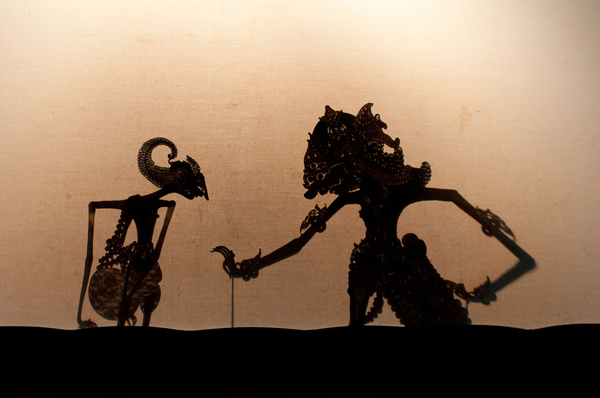
Wayang Kulit in Yogyakarta
Wayang is very often accompanied by a gamelan orchestra, a traditional Indonesian instrument. The dalang is the artist who brings the puppets to life. He stands behind a screen and in front of a lamp. The orchestra is positioned behind the dalang, who is responsible for singing, voicing his characters and directing the musicians. Stories and narration methods were once transmitted within families through oral tradition. It is hardly surprising that dalang artists hold a highly respected place within Indonesian society.
It is moreover possible to admire the dalang's work from behind the curtain to get a view of his gestures and technique during a performance.
In 2008, UNESCO inscribed wayang on the Representative List of the Intangible Cultural Heritage of Humanity. Indonesian theatre brilliantly showcases the artistic talent of the archipelago's traditional spectacles.
The different forms of wayang
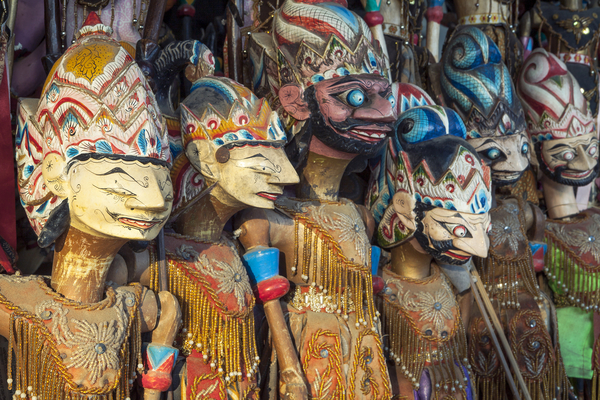
Wayang golek puppets, Yogyakarta
The term wayang generally encompasses many forms of theatre, the most well-known of which are wayang topeng and wayang orang. Wayang topeng is a masked performance while wayang orang is danced.
Over time, wayang underwent many evolutions, resulting in the diversity of narration styles. Shadow puppet theatre varies from region to region, and the appearance of the puppets also varies accordingly. For example, wayang golek presents audiences with wooden puppets dressed in traditional costumes. It is the most common form of theatre in the West Java region.
Painted, carved, polished… these puppets are the result of meticulous and precise artisanal techniques. The work of artisans is as important as that of the dalang. They also contribute to creating elaborate puppets whose size and appearance vary depending on the character represented.
In Java, wayang kulit remains the origin of all other forms of theatre. Wayang wong, on the other hand, is danced by real people who copy and reproduce the movements of puppets.
Today, many shadow puppet theatre companies teach and perform in Indonésie. The most renowned remain those of Sri Wedari in Surakarta and Bharata in Jakarta. As a heritage to be transmitted, the Indonesian government notably encourages universities to offer a teaching section dedicated to the art of traditional theatre.
Wayang is a spectacle that continues to fascinate travellers and Indonesians alike, and we sincerely hope you will have the opportunity to experience it during a visit to the Indonesian archipelago!