Pencak-silat
Pencak-silat is the traditional martial art of Indonésie. It brings together two streams of martial arts practiced in Madura, Bali and Java, pencak, and silat originating from the island of Sumatra. These martial arts are also practiced in Malaysia, Singapore, southern Thailand, Brunei and the Philippines.
Pencak-silat is the traditional martial art of Indonésie. It brings together two streams of martial arts practiced in Madura, Bali and Java, the pencak, and silat originating from the island of Sumatra. Silat martial arts are also practiced in Malaysia, Singapore, southern Thailand, Brunei and the Philippines.
Each region has developed its own style, and there are many schools of pencak-silat (between 700 and 1,000 or so) distributed mainly in Indonésie and Malaysia. Pencak-silat stands out from other martial arts through the use of « vital force » - tenaga dalam - and through getaran, a technique used to develop perceptual abilities (distant touch, spatial perception, etc.)
Merpatih Putih, the main pencak-silat school in Indonésie :
One of the main schools of pencak-silat remains Merpatih Putih. Its origins date back to around 1550. After being transmitted secretly from father to son for nearly 400 years, Saring Hari Poermono, descended from the tenth generation of initiates, decided to share the knowledge and secrets of his family. In 1963, in Yogyakarta, he formalized the school under the name « Merpatih Putih ». It wasn't until 1999 that the first Westerners, two American brothers, were initiated into these practices.
The philosophy of Merpatih Putih school can be summed up by the following phrase: « Mencari sampai mendapatkan tindakan yang benar dalam ketenangan », which in English means: « Seek, until you attain right action through the voice of inner peace ». Merpati putih also means « white dove » in Indonesian.

Logo of the Merpati Putih school (source: http://carakabayuwibawa.blogspot.co.id/2016/10/merpati-putih.html)
Practicing this discipline implies adherence to certain values and types of behaviour, symbolized by the school's logo. Each element of the emblem carries a specific meaning. Thus white signifies purity and perfection, while the dove is a universal symbol of peace. The white and red colours can evoke those of the Indonesian flag.
Red represents the ardour one must put into seeking calm, while blue symbolizes inner peace and balance. The hand and black colour are symbols of firmness of heart. Indecision, turmoil, imbalance are attitudes incompatible with the practice of pencak-silat. The open right hand represents open-mindedness and tolerance, accompanied by truth and justice. The gold surrounding it is a sign of nobility and grandeur. Finally, the bowed head of the dove symbolizes the absence of arrogance and pretension.
The practice of pencak-silat
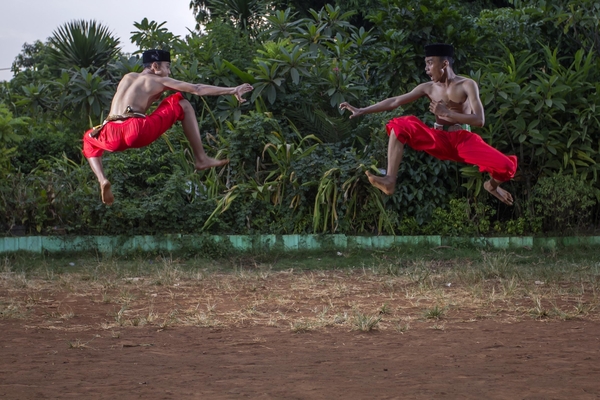
Pencak-silat demonstration © Andreas H. via Shutterstock
Practitioners of this martial art, called « pesilat », may fight with weapons or bare-handed. They learn in particular to develop 5 categories of skills:
- Movements
- Management of vital force (tenaga dalam)
- Combat techniques
- Healing, soothing energy
- Getaran perception with loss of sight
Attack, defense, and mastery movements of the opponent, and the application of these movements in actual combat are a foundation common to all martial arts. However, pencak-silat sets itself apart from other martial arts through the integration of yogic techniques, likely stemming from Indian culture.
Tenaga dalam
Thus, from the first months of practice, training incorporates breathing exercises designed to develop vital force, or tenaga dalam present in each individual. If tenaga dalam is sufficiently developed and properly channelled, it allows intermediate pesilat to use an internal power force. The latter is the result of breathing exercises, meditation and great concentration.
Tenaga dalam has two main applications: the breaking of hard objects, as well as healing use. In the latter case, in the event of injury during combat, the advanced pesilat places his hands a few centimetres from the injured area. The sensations felt—heat, cold, tingling, etc.—allow him to pinpoint the exact position and nature of the ailment. The disciple can then, through energy exchange, rebalance the energetic flow and relieve the suffering of the injured person.
Getaran
Getaran is a second point contributing to making pencak-silat a unique martial art. Physically speaking, each substance has its own vibrational frequency. The world around us is composed of atoms that vibrate continuously. Breathing exercises and meditation aim to sensitize the body to these very subtle vibrational frequencies.
The pesilat, forgetting his internal sensations, works to develop his receptivity to the external world. Thus, an advanced disciple is capable of identifying differences in vibrations emanating from different substances. With eyes blindfolded, he can even sense and differentiate the characteristics of any object surrounding him (speed, shape, size, etc.).
According to members of the Merpatih Putih school, getaran is nothing like a magical or supernatural power, as one might think at first glance. Jean-Marc de Grave, French orientalist and specialist in Malaysian martial arts, explains that in the human being, « various elements contribute to the existence of a very elaborate perceptual apparatus, capable of supplementing the sense of sight. » Practice and training are therefore the keys to obtaining sharp control of one's senses.
Pencak-silat today
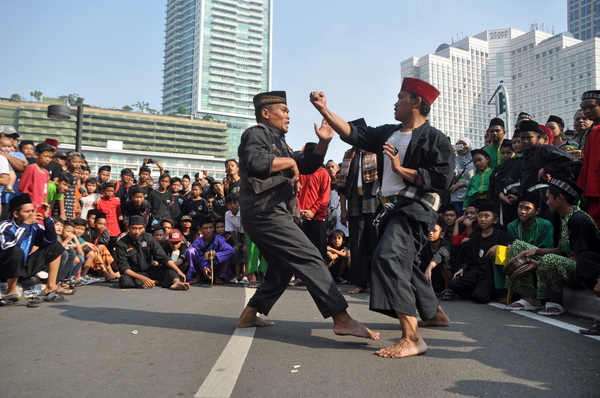
Pencak-silat demonstration in Jakarta © by Dani Daniar via Shutterstock
The traditional Indonesian martial art remains little known to the general public even if its development in the West is gradually increasing. There are also several branches of pencak-silat in Indonésie including one bringing together hybrid schools adapting teaching to foreigners. Schools established in Europe and the United States primarily use this one. Furthermore, many countries are beginning to host pencak-silat competitions, including France and the Netherlands. The goal also remains to make this martial art better known.
In France, pencak-silat was introduced by Charles Joussot, founder of FISFO (Federal International System Forces de l'Ordre). Many associations such as the AFPS (Association France Pencak-Silat), created in 1994, also contribute to the development of the practice.
If you feel like trying this martial art, don't hesitate to take an introductory lesson to familiarize yourself with pencak-silat! Who knows, perhaps you'll have a revelation?
To learn more on the subject:
- Jean-Marc de Grave, « Quand ressentir c'est toucher, techniques javanaises d'apprentissage sensoriel», Terrain, numero-49
- Official Merpatih Putih USA website, http://mpusa.50megs.com/Training.htm
- Paris Pencak Silat Association website, http://info.apps.free.fr/cours.php?fname=mpinstructeur.html
Article written by Lisa C.