Gentle Java
Spanning 128,000 km², Gentle Java is one of the principal islands of the Indonesian archipelago. Offering sumptuous landscapes, it promises visitors enriching cultural discoveries.
Geography of Java
Spanning 128,000 km², Gentle Java is one of the principal islands of the Indonesian archipelago. Offering sumptuous landscapes, it promises visitors enriching cultural discoveries.
Its name Java derives from the word javadvipa, drawn from the Ramayana, which means "island of millet." The island is generally divided into four provinces: Banten, at the western tip, Jawa Barat (West Java), Jawa Tengah (Central Java), and Jawa Timur (East Java). It is bordered by the Indian Ocean to the south and the Java Sea to the north. To the west lies the Sunda Strait, separating the island of Sumatra, and to the east the strait of Bali. There are also two special territories: Jakarta and Yogyakarta.
Java is home to approximately 150 million inhabitants, nearly 60% of Indonésie's population, making it the most densely populated island of the Indonesian archipelago.
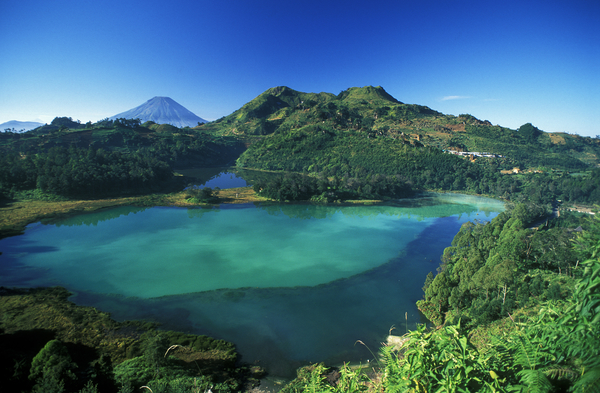
The volcanic lake Telaga Warna, in Java
Jakarta, the capital, is located to the north and represents the historical, political, commercial, and financial center of the island. The main cities of Java remain Surabaya, Bandung, and Semarang. There are also beautiful royal and princely cities such as Yogyakarta, Surakarta, and Cirebon.
Java, between natural, ethnic, and cultural riches
As throughout Indonésie, several ethnic groups coexist on the island. The Javanese, who form the largest ethnic group, possess a refined and delicate culture where the performing arts intermingle with tradition and modernity. In the west, you will find the Sundanese, and in the east, the Madurese. Thus, each people possesses its own traditions, its own culture, and its own language.
The vast majority of the population in Java is Muslim. However, there are some exceptions, such as the Indonesian minority of Chinese origin, generally Christian or Confucianist. Also, part of the population in Jawa Timur is Hindu, and the natives of Banten are animist.
Indonésie is known for the diversity and richness of its fauna and flora. Rice fields, volcanoes, and jungle mark the Javanese landscapes. Indeed, enriched by volcanic ash, the soils are very fertile and allow the population to live from agriculture. Nowadays, there are around fifty volcanoes on Java, including the famous Ijen Mountains, Merapi, and Bromo.
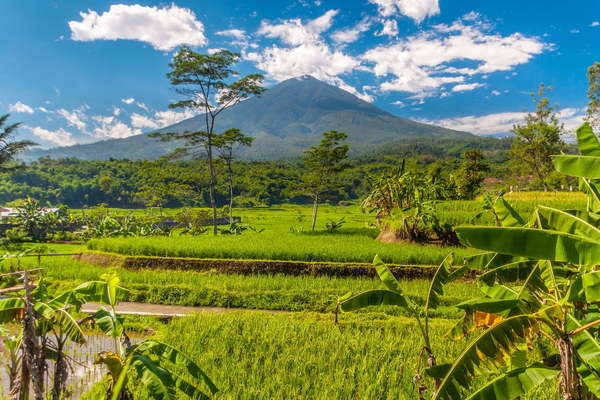
The Gunung Guntur volcano, in Java, photo © Judith Lienert via Shutterstock
It also boasts numerous natural reserves such as Ujung Kulon, which protects the last Asian rhinoceroses. Beautiful temples, such as Borobudur and Prambanan, stand proudly in Jawa Tengah, marking its rich Buddhist and Hindu historical heritage. The beautiful islands of Seribu, Kangean, and Karimunjawa, for their part, enhance Java's northern coast.
Thus, the island abounds with treasures to discover, and a stay on it promises beautiful visits in verdant and diverse landscapes. Many places remain interesting to visit in Java, for an enriching and fascinating Indonesian immersion.