Indonesian Papua: A Journey Back to the Stone Age
In 1992, as a young photographer fresh from one of Brussels' most prestigious schools, I seized the opportunity to satisfy my hunger for photographic adventure. My very first photo reportage was
In 1992, as a young photographer fresh from one of Brussels' most prestigious schools, I seized the opportunity to satisfy my hunger for photographic adventure. My very first photo reportage took me to Western New Guinea (Indonésie), to capture the ancestral rites of several Papuan tribes from the highlands of Irian Jaya. These images were later discovered by the renowned Gamma news agency, which distributed them worldwide.
The text below is an updated version of the article I wrote at the time to accompany the series of photos selected by Gamma Agency.
One of the last frontiers of adventure
At a time when modern man has already set foot on the Moon and sent spacecraft to other planets in the galaxy, there still exist on our Earth a few places preserved from Western civilization. New Guinea is indeed one of the last lands where certain regions remain unexplored and where several Papuan peoples still live as our ancestors did in the Stone Age. New Guinea belongs to the Melanesian world, and the general morphology of Papuans, their dark black or brown skin, a certain manner of behaving, moving and laughing echo the African continent. Even the shape of houses and huts evokes Africa.
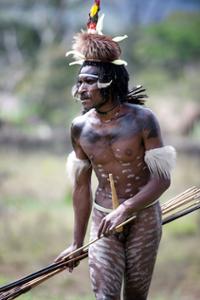
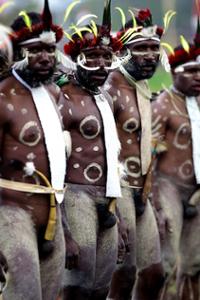
The origin of these populations remains mysterious. Many historians believe, however, that they arrived in successive waves from southwestern Asia, millennia before the Christian era, progressively moving south and east to populate distant lands beyond even Australia. There are the pygmoid peoples of the mountains and the coasts of the northeast, the Polyno-Papuans with lighter skin and the Malo-Papuans whose origins trace back to the Proto-Malay invasion. The common traits of these three groups are characterized first by the primacy of the group over the individual, hence belonging to a family; then by an absolute respect for ancestral traditions and conformity in daily life. Any act of originality or innovation is thus seen as nonsensical and brings exclusion from the group. These are the essential factors in the immobility of these societies across centuries.
An accelerated leap into the future
In the nineteen-fifties, many regions of Papua–New Guinea (the eastern part of the island) were still untouched by any trace of white man, inhabited by irreducible and warring tribes. But since then, Australian power and its desire for discovery have advanced civilization at a forced pace. In less than thirty years, these tribes were approached and "pacified", often by force. Irian Jaya, annexed by Indonésie in 1963, remains by contrast less studied and there are still very few roads* allowing travel within the country. Movements occur only by river or plane. And civilization spreads like an oil stain from the missions, but its influence on the natural environment is virtually nil. As a result, some territories remain inaccessible. * The current Indonesian president, Joko Widodo, has undertaken, since taking office in 2014, a vast road construction program that notably connects the north, center and south of the Papuan province.
Tourism development since the late 1980s
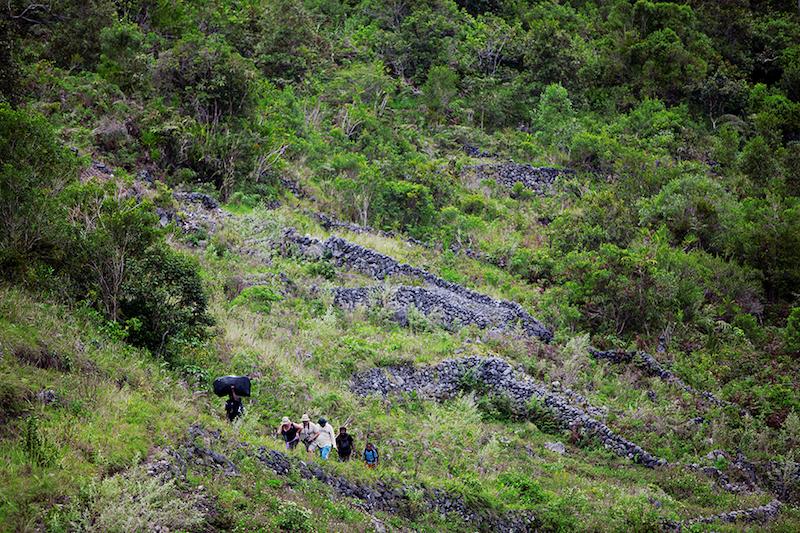
Economic development is moreover limited to coastal regions and a few valleys, including the one crossed by the Baliem River, in the highlands of former Irian Jaya. This "happy valley" was discovered in 1937 by Richard Archbold and rediscovered by chance in 1945, when an American plane made a forced landing. And since the late 1980s, tourism has developed exponentially in this region, as if the authorities were concentrating here everything they forbid elsewhere. It is tourism almost exclusively involving physical effort and trekking, since there are no roads worthy of the name. And barely thirty years ago, no one came to Wamena, the valley's only town, unless they had good reason to do so. There are now tourist circuits and local guides work with foreign travel organizers.
"Valley of the cannibals"
Approximately 100,000 Dani live in the Baliem Valley, still called the "valley of the cannibals". Seventy-two kilometers long, about thirty kilometers wide and perched at 1,700 meters altitude, it remains accessible only by plane. Among the 750 tribes (and as many dialects) of Irian Jaya (which means "victorious Irian" in Indonesian), the Dani are certainly the most experienced in agriculture. They practice slash-and-burn cultivation, terrace and perfectly irrigate their fields, protected by simple stone walls. These fields are often clinging to the steep flanks of mountains, and the slopes are sometimes so steep that Papuans must dig with one hand while holding onto the earth with the other. Sweet potato—a sweet variety of potato—ginger, cucumber, sugarcane and banana constitute the main crops, while pigs, practically the only livestock raised, have both a sacred and commercial function. They are the central pivot of Papuan life and are slaughtered in particular circumstances, notably at social or religious festivals, at weddings or funerals. They are then cooked in a pit dug in the ground, covered with successive layers of hot stones and various leaves. They are so important that it is common to observe a woman nursing a piglet alongside her own children. The theft of a pig is, moreover, one of the main reasons for conflict. And, just as the abduction of a woman, it could lead, even fifty years ago, to a head hunt, the aim of which was to appropriate the enemy's worth, who was then eaten. Cannibalism has today disappeared from the Baliem Valley, but it is possible that regions of Irian Jaya untamed by civilization and inhabited by the last anthropophages still exist. They are located at the boundary between the highlands and lowlands of the country's south.
Imposing and hostile nature
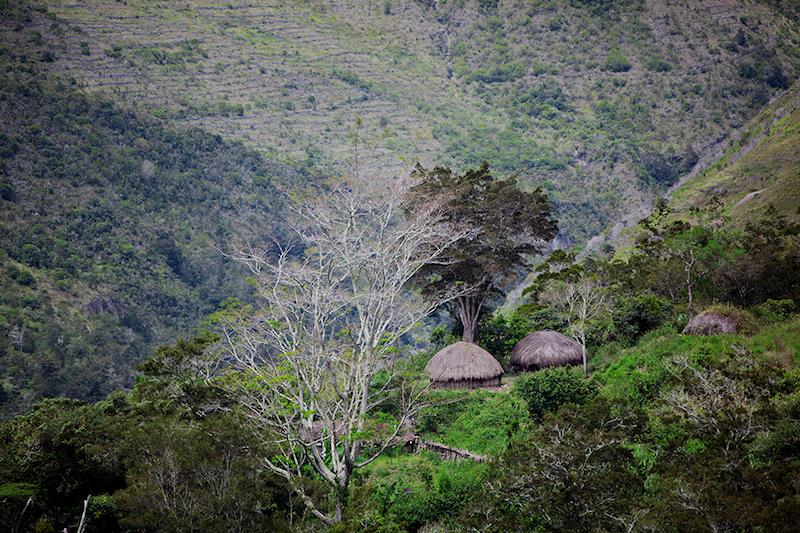
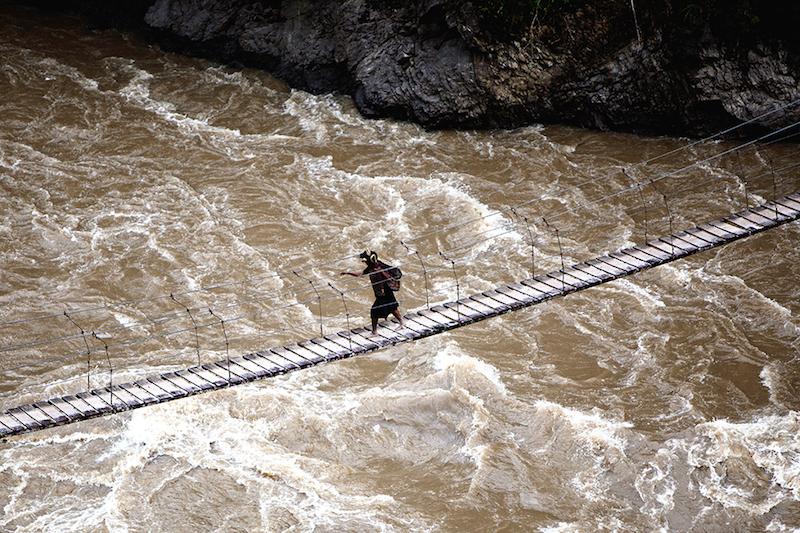
Despite temperatures that can drop to 5°C, the Danis live practically naked. Men wear only a simple penis sheath made from dried bottle gourd (koteka in Papuan) and women wear only short "skirts" of reed fibers that conceal neither round bellies nor wrinkled breasts. These men and women live amid hostile nature, made of jagged mountains, lost valleys, tumultuous rivers, rain, mud, fog, cold, cliffs, gigantic chasms, sharp ridges and impassable gorges. And crawling under tree trunks, climbing rain-slicked piles of rocks, skirting precipices, straddling countless obstacles—such is the daily lot of the Dani in this jungle with 700 bird species (including the famous Bird of Paradise), silent, humid and cold, where moss and ferns hide holes amid a tangle of rotting vegetation. Mud is omnipresent, sticky... Fortunately the wide, flat feet of Papuans grip it better! The Danis thus live in relation with this imposing and hostile nature, in a highly chaotic habitable space. The rugged terrain does not favor exchange and low agricultural productivity tends toward village isolation. Villages are protected by wooden palisades with one or two entrances. Houses are built from squared logs, separated from each other by spaces of packed earth where pigs run. The entrance to the huts is small and narrow, proportional to their inhabitants. The term "hamlet" would actually be more fitting for these villages, which are never very large or very populated.
Communication with the living
And traditional Papuan life often continues parallel to new customs and beliefs brought by outsiders. The Danis believe, for example, in eternal life, and especially that the dead remain in communication with the living. It is therefore not uncommon to see, in certain villages, ancestors preserved through smoking. And they still use ancient tools and weapons, such as polished black wood bows, strung with very flat bamboo strips that are tied at the ends. The arrows have points of different shapes depending on their use: barbed, diamond-shaped, lanceolate, trident-shaped, and even round ones for hunting birds. Not to mention the axes that also make Papuans famous. They are composed of a sharpened and polished stone point fixed to the handle with defibered liana that was wetted during manufacture to tighten as it dried. The handles are pieces of V-shaped wood with unequal branches that can be carried on the shoulder.
Submission to modern civilization
Despite a certain submission to modern civilization, willingly or by force, and through chance encounters with foreigners in the Papuan jungle, only the youngest are truly influenced by "white" culture. For the elders wish to proudly preserve what remains of their ancestral traditions. All the more so because they have experienced, in less than fifty years, an enormous psychological shock in making a terrible leap into the future. And it is certainly the appearance of the God of Money that has most disoriented them: the frenzied acquisitiveness of Papuans now makes them monetize everything that can be monetized, and this frenzy is all the greater because these men are torn between their old culture and that from the West. In Papua–New Guinea, more independent, one witnesses delinquency that spares neither cities nor countryside, terrorized by numerous bands of thugs. Of course, some Papuans of Irian Jaya rebelled against this inquisition by attempting to drive all foreigners from their lands. And the departure of the Australians in 1975, leaving Papua New Guinea free and independent, revitalized their determination. Many indeed wished to take the opportunity to create a single Papuan state by uniting the two territories in the same cultural universe and geographic entity, but the Indonesian government heard nothing of it. Thus was born the OPM, the Papuan independence movement, whose survivors were forced to take refuge in the most inhospitable and uncontrolled areas of the country, after a large number of supporters were exterminated by napalm bombs in recent years.
Cultural annihilation
Culturally and socially annihilated, the Papuans are but a shadow of themselves. They remain apathetic to the progressive invasion of their territories by Indonesian settlers, driven by an inevitable policy of modernization. Like animals in an immense cage without bars, they exist only to entertain travelers, and make their final cry of distress, knowing they cannot prevail as long as they have only spears, bows and arrows against the formidable air-to-surface missiles of the Indonesian air force.
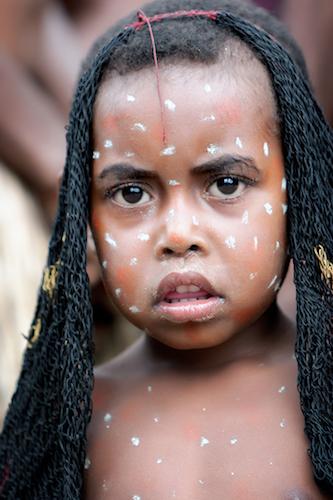
And, to the detriment of nature and indigenous populations, plans for mining and oil prospections remain underway, even though organizations such as Survival International have managed to throw some spanners in the works of the Indonesian administration. In short, Papuans must submit to new ways of life or disappear. This people, upon whom Time seems to have no influence, is dying. It is in its death throes and practically no one cares. The West has no time to concern itself with the fate of Papuans. The past is no longer relevant. Unfortunately, a people dies, the sole guardian of Time's memory. Let us try to preserve this memory. Dominic CLARISSE