Indonesian Traditional Costumes
A nation is often symbolized by its traditions and clothing customs. When thinking of Indonesia, one easily imagines beautiful Balinese dancers dressed in vibrant and refined fabrics
A nation is often symbolized by its traditions and clothing customs. When one thinks of Indonésie, one easily imagines beautiful Balinese dancers dressed in vibrant and refined fabrics, adorned with ornaments and gold jewelry. But it must be understood that these traditional costumes vary widely from one region and ethnic group to another. There are thus more than thirty provinces in Indonésie. Each one possesses its own traditional clothing.
Batik, kebaya and sarong: masterpieces of Indonesian traditional dress
Most Indonesian costumes belong to the Javanese, Sundanese and Balinese cultural heritage. This is the case, for example, with batik and kebaya. As in many Southeast Asian countries, Indonesian men and women generally wear the sarong. This is a large piece of fabric that they fold and tie around their waist.
Batik and peci:
During ceremonies or special occasions, men often pair the sarong with a batik shirt. The motifs of this Indonesian fabric vary depending on the region and depend on local culture. Batik is inscribed by UNESCO on the intangible cultural heritage of humanity.
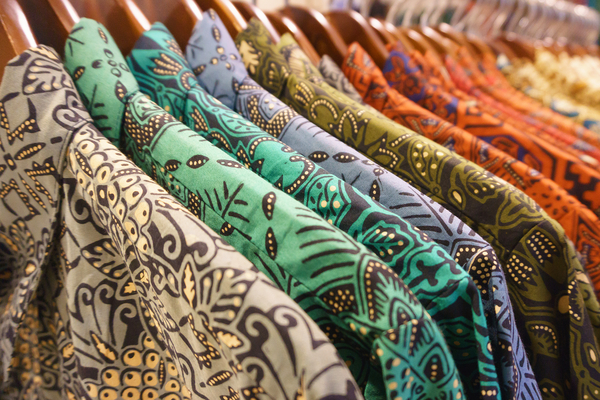
Batik shirts, traditional Indonesian garment
Many Indonesian politicians, including former president Sukarno, popularized the wearing of the peci or songkok. This is a headdress, most often in black, worn by Indonesian Muslims. It is very similar to the Turkish and Egyptian fez. A true Indonesian national symbol, the peci is an essential attribute of presidential attire. Men wear it for major occasions.
The kebaya for Indonesian women:
The traditional garment of Indonesian women is the kebaya, now considered a national dress. It is a colorful long-sleeved blouse that can be made of silk, cotton or semi-transparent nylon. This blouse is often embroidered or decorated with a floral motif. Women wear the kebaya with a sarong. They then tie their hair into a bun, adorned with silver or gold flowers.
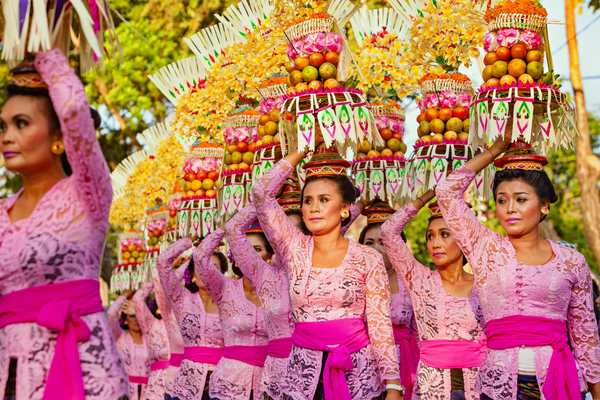
Balinese women dressed in traditional kebaya during a religious procession
Once, only members of the Indonesian royal family or nobility had the right to wear this outfit. During the Dutch colonial period, European women appropriated it for themselves. Nowadays Indonesian women wear it regularly for weddings or religious festivals.
Like the peci, Indonesian personalities dress in a kebaya for national or international events. For example, it is not uncommon to see the Indonesian First Lady dressed in this way.
Indonesian Regional Costumes
Regional costumes, called baju adat, depend heavily on the ethnic group to which Indonesians belong. Thus hats and other headdresses differ by region. For example, in Bali, you will find the udeng and in Java, the blangon. They are distinguished by their folding and motif.
Gold and crowns: symbols of Indonesian cultural wealth
The same goes for women, especially with regard to crowns. The jamang is generally associated with Balinese and Javanese dancers. This rich ornament comes from the Hindu and Buddhist heritage of Indonésie. The design of these crowns varies from region to region, and women wear them for the same occasions. So do not be surprised to see a Minang bride wearing a headdress called suntiang, which does not really look like a jamang crown.
Indonesian dancers favor sparkling outfits adorned with gold. Like the jamang inherited from Hindu influence, the Ramayana ballet will take you back to the time of the ancient kingdoms of Indonésie, when Indian epics were celebrated through dance and theater. The costumes are therefore a delightful blend of gold, jewels, precious stones, silk and batik.
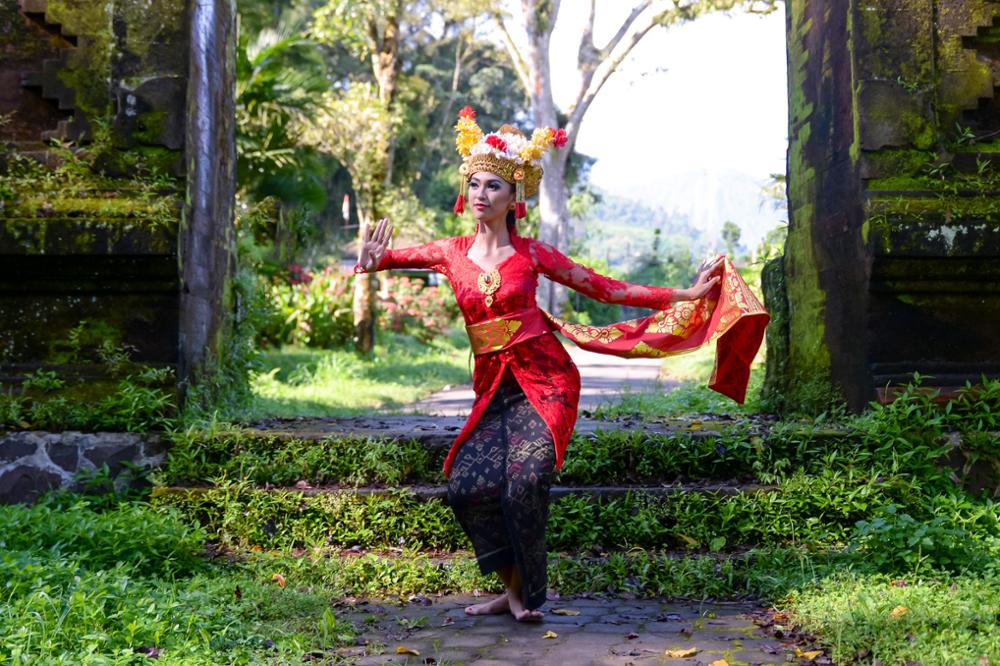
Balinese dancer adorned in her traditional stage costume
Other types of traditional attire exist such as the baju koko. This is a blouse that Muslim men prefer for religious occasions. Like the batik shirt, it is worn with a peci and a sarong.
Thus, women from certain communities in Sumatra also dress in a baju kurung, a Malaysian-origin shirt that resembles a tunic. In southern Sulawesi, the baju bodo is preferred, with shorter sleeves.
When they want to stay home and be comfortable, Indonesian women prefer informal, loose and colorful dresses called daster. Since Indonésie is a country with a predominantly Muslim population, many women cover their hair with a hijab or jilbab.
Indonesian style: between tradition and modernity
Rich in many cultures, the history of Indonesian clothing is what characterizes its people today. It is emblematic of the ethnic diversity at the origin of the socio-cultural foundations of the Indonesian archipelago. You will be delighted to discover for yourself the beauty and richness of its sartorial heritage.
Many Indonesian artists and fashion designers use traditional fabrics and draw inspiration from the emblematic clothing of their country to create their fashion shows and collections. One thinks in particular of Tex Saverio or Biyan Wanaatmadja. As true cultural ambassadors of Indonésie, they regularly dazzle the world of haute couture with the both modern and traditional style of their creations.

Indonesian fashion designer Anne Avantie presenting her haute couture collection during the 2015 Fashion Week in Jakarta
If you wish to get a glimpse of the clothing culture of Indonésie, do not hesitate to visit the Taman Mini Indonesia Indah Museum, in Jakarta. It has a section dedicated to the costumes and traditional clothing of each Indonesian region. And if you are passing through Bali, perhaps you will also have the opportunity to attend beautiful Hindu ceremonies?