1806
Napoleon was briefly the "master" of the Dutch East Indies between 1806 and 1811 (the British took over until 1815, then returned the archipelago to the Dutch). The defeat of the...
Did you know that France ruled the Dutch East Indies (present-day Indonésie) in the early nineteenth century, at the height of the Napoleonic empire? The article below explains the circumstances.
Napoleon was briefly the "master" of the Dutch East Indies between 1806 and 1811 (the British took over until 1815, then returned the archipelago to the Dutch). The defeat of the Netherlands by the French Empire, as well as the dissolution of the Dutch East India Company (the famous V.O.C.), led to profound changes in the colonial administration of the archipelago, all the more so because one of the Napoleonic wars was waged in Java. This period, which lasted nearly a decade, witnessed numerous upheavals in Java, due to ambitious infrastructure and defense projects, followed by battles, reforms, and major upheavals in the colony's administration.
Prelude
In 1800, the Dutch East India Company (Vereenigde Oost-Indische Compagnie - VOC) declared bankruptcy and was nationalized by the Batavian government. As a result, all the company's assets, which included ports, warehouses, fortifications, colonies, lands, and plantations, were consolidated and formed the foundation of the Dutch East Indies, controlled by the Kingdom of the Netherlands. From their capital Batavia (present-day Jakarta), the Dutch thus had control over most of Java (except for the interior lands of Yogyakarta and Banten), and conquered the west coast of Sumatra, former Portuguese colonies in Malacca, the Moluccas, the south and north of the Celebes (present-day island of Sulawesi), and also western Timor. Among the Dutch possessions, Java was considered the most important, as it concentrated the production of commercial crops and plantations under Dutch control.
On the other side of the world, Europe was being ravaged by the Napoleonic Wars. One conquest and one revolution, and the policies, relations, and dynamics between empires and European nations were turned upside down, consequently affecting their colonies in the Far East. The Netherlands under Napoleon Bonaparte in 1806 became the Batavian Republic, then the Dutch Common Market, which was itself dissolved and replaced by the Kingdom of Holland, a French puppet kingdom ruled by Napoleon's third brother, Louis Bonaparte (Lodewijk Napoleon). During this entire period, the Dutch East Indies were therefore considered a French colony, administered under the tutelage of Amsterdam.
The struggle for power and rivalry between France and Great Britain also manifested itself elsewhere in the world, involving the colonies of the two empires in the Americas, Africa, and Asia. Since 1685, the British had indeed consolidated their dominance at Bencoolen on the west coast of Sumatra (the present province of Bengkulu), and had also established their dominance in the Strait of Malacca, in Singapore and Penang. While they coveted the Dutch colonies in the region, the East Indies controlled by France thus prepared for a British invasion.
French Interim, 1806 to 1811
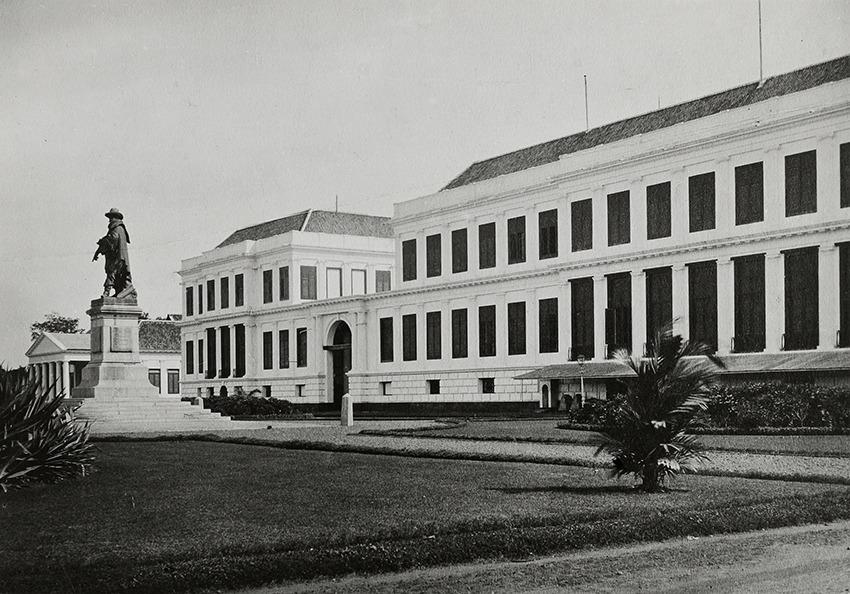 Daendels Palace on Waterloo Square in Batavia (Anonymous – KITLV Leiden)
In 1806, King Louis Napoleon of the Netherlands appointed one of his generals, Herman Willem Daendels, as Governor General of the East Indies. His mission was to strengthen the Javanese defenses against an imminent British invasion. He landed in Batavia on January 5, 1808, and immediately replaced his predecessor, Albertus Wiese. Thanks to him, the army of the Dutch East Indies was reinforced, new roads were built in Java, and the internal administration of the island was generally improved.
Daendels' authority had to be harsh and martial, so that the colony could prepare for the British threat. He had new hospitals and military barracks built, new arms factories in Surabaya and Semarang, as well as a new military school in Batavia. The Batavia fortress was also destroyed and replaced by a new fort at Meester Cornelis (present-day Jatinegara, in the eastern suburbs of Jakarta). Fort Lodewijk was also erected in Surabaya. Among Daendels' many achievements, one of the most famous remains the construction of the Great Post Road (Jalan Raya Pos in Indonesian) which crosses the entire north of Java, from Anjer to Panaroecan. This road, called Jalur Pantura, long served as the main route between the two ends of the island, before a highway (nearing completion) replaced it. This road of approximately one thousand kilometers was completed in just over a year, during which thousands of forced Javanese workers lost their lives.
The reign of the Catholic king Louis Napoleon in the Netherlands also ended centuries-old religious discrimination against Catholics in the Netherlands and the East Indies. Until then, the Netherlands had indeed favored only Protestantism. Catholics thus regained their freedom of worship in the Dutch East Indies, although the new law was originally intended mainly for European Catholics, since Daendels ruled under the authority of Napoleonic France. This religious freedom would later be consolidated by Thomas Raffles.
Daendels – renowned as a passionate Francophile – had a new palace built in Batavia, a miniature version of the Palace of Versailles known as the "Daendels Palace" or "Witte Huis" (White House) and often called the "Groote Huis" (Great House). This palace is nowadays the office of the Indonesian Ministry of Finance, east of Lapangan Banteng (formerly Waterlooplein). He also renamed the Buffelsveld (buffalo field) to Champs de Mars (since become Independence Square). Another of Daendels' great works was finally to have continental law fully adopted in the colonial legal system of the Dutch East Indies, a law that has endured over time and is still found today in the Indonesian legal system. Indonesian law is often considered to be part of the group of "civil law" or "continental" legal systems, similar to those of European countries such as France and the Netherlands.
Daendels' firm behavior toward local Javanese leaders, however, had the consequence of their preference to collaborate with the British against the Dutch. It was moreover Daendels who subjected the Javanese population to forced labor (Rodi). He also subjected the population of Java to forced labor (Rodi). And rebellions were not lacking, such as that of Cadas Pangeran, in western Java. Daendels is finally responsible for the abolition of the Sultanate of Banten. In 1808, Daendels ordered Sultan Aliyuddin II of Banten to move the capital of the sultanate to Anyer and to provide labor for the construction of a new port at Ujung Kulon. When the Sultan refused, Daendels ordered the invasion of Banten and the destruction of the Surosowan palace. The Sultan and his family were arrested at Puri Intan and detained at Fort Speelwijk, before being sent into exile in Ambon. On November 22, 1808, Daendels declared from his headquarters in Serang that the Sultanate of Banten was now part of the Dutch East Indies.
In 1815, the Netherlands regained control of the island of Java following the Napoleonic Wars and in accordance with the terms of the Anglo-Dutch Treaty of 1814. In 1816, the Dutch assumed full control of their colony in Java and in other regions of the archipelago. And from that date onward, the Batavians launched themselves into their conquest of the rest of the archipelago. They definitively consolidated their colony in 1920, which became one of the most profitable European colonies in international colonial history.
Translated from English by Dominic Clarisse (Source: Dutch Docu Channel)
*Cover photo: Herman Willem Daendels, Governor-General of the Dutch East Indies (1808-1811) - Painting by Raden Saleh (KITLV Leiden)