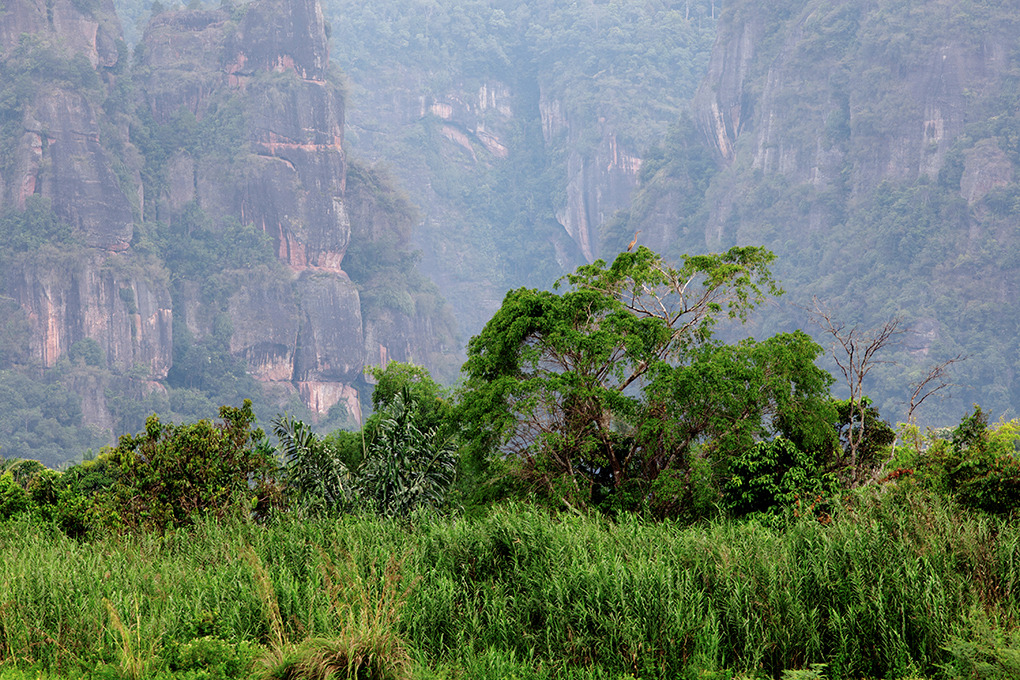
Sebangau
An immense peatland forest at the heart of Borneo, Sebangau National Park protects one of the largest wild orangutan populations. A raw conservation territory, far from mainstream tourist circuits.
Sebangau National Park stretches across the peatlands of Borneo, in the heart of Central Kalimantan province. This vast tropical forest ecosystem on peat is home to one of Borneo's largest wild orangutan populations (Pongo pygmaeus). It is a major conservation territory, still largely untouched by mass tourism, accessible from the provincial capital Palangka Raya.
Practical information at a glance
- Access: departing from Palangka Raya, primarily by boat along the Sebangau and Katingan rivers
- Recommended duration: minimum 2 days to increase chances of observing orangutans
- Clothing: long, covering garments, waterproof boots essential in peatland forest
- Guide mandatory: independent visits to the park are not advised; a local guide is required to navigate through dense forest
- Best season: dry season (June to September) for less flooded trails
What to see
Sebangau's peatland forest is a unique environment: spongy soil, dark waters tinted by tannins, trees with interwoven aerial roots. Wild orangutans can be observed in their natural habitat, alongside gibbons, macaques, proboscis monkeys, and a rich avifauna including the rhinoceros hornbill. The rivers are home to Siamese crocodiles and Irrawaddy freshwater dolphins.
History and context
The region has long suffered from deforestation and peatland fires, particularly following an agricultural conversion project in the 1990s. The national park was officially established in 2004 to protect what remained of the forest. International NGOs and local teams have since worked on orangutan rehabilitation and hydrological restoration of degraded peatlands.
Highlights of the visit
Orangutan observation
Local guides know the nesting areas and fruiting trees frequented by orangutans. Observation is conducted on foot or by dugout canoe, depending on the season and water level. Patience is essential: encounters are never guaranteed.
Navigation by dugout canoe on the black rivers
Traveling upriver through dark waters at sunrise is a powerful sensory experience. The silence, morning mist, and calls of gibbons compose an unforgettable tableau.
Research station and awareness
Some operators offer stays that include visits to orangutan research stations, where scientific teams monitor wild individuals. A concrete way to understand conservation challenges.
Photography tips
Light in the understory is low: favor a bright lens or increase ISO. Early morning offers the best filtered light and animals are more active. Avoid flash near orangutans. Reflections of dark waters on roots create striking graphic compositions.
Location and access
The park is located southwest of Palangka Raya, the capital of Central Kalimantan. Main access is by motorized boat from landing points near the city. Palangka Raya is connected by domestic flights to Jakarta, Surabaya, and Balikpapan. Accessibility for people with reduced mobility is very limited due to the unimproved natural terrain.
Nearby attractions
- Palangka Raya — the departure city, essential logistics hub for organizing the expedition.
- Tanjung Puting National Park — another orangutan sanctuary in Kalimantan, more frequented, accessible from Pangkalan Bun.
Want to discover this destination?
Our local advisors design your tailor-made trip.