Banjarmasin
Banjarmasin
Banjarmasin, capital of South Kalimantan province, sprawls across a delta of canals and rivers in the heart of Indonesian Borneo.
Banjarmasin, capital of South Kalimantan province, sprawls across a delta of canals and rivers in the heart of Indonesian Borneo. Nicknamed "the city of a thousand rivers," it pulses to the rhythm of water: floating markets at dawn, pirogues laden with fruit, mosques on stilts. It's a gateway to Borneo's forests and an essence of Banjar culture, blending Islam, riverine commerce, and diamond craftsmanship.
Practical Information at a Glance
Access: Syamsudin Noor international airport (BDJ), approximately 25 km from the city center.
Local transport: klotok (motorized pirogue) for the canals; ojek (motorcycle taxi) and angkot (minibus) around town.
Dress code: covered clothing recommended when visiting mosques; shoulders and knees covered.
Recommended duration: 2 to 3 days to combine floating markets, historic neighborhoods, and forest excursions.
Floating market: must visit early morning (before 8 a.m.); activity drops off rapidly afterward.
What to See
The city reveals itself from the water. Klotoks glide past stilt houses, spice warehouses, and mosques whose reflections shimmer on the Martapura River. On land, the Pasar Lama district concentrates precious stone boutiques and diamond-cutting workshops — Martapura, nearby, is the historic center of this trade. Covered markets overflow with dried fish, jaggery, and tropical fruits.
History and Context
Founded in the sixteenth century on the banks of the Barito, Banjarmasin was the capital of the Banjar Sultanate, one of Borneo's most powerful kingdoms. Islam took firm root here from that era onward. The city became a regional commercial hub thanks to pepper, rattan, and diamonds extracted from the hinterland. Dutch colonization in the nineteenth century left some architectural traces, but Banjar culture remains dominant.
Highlights of Your Visit
Lok Baintan Floating Market
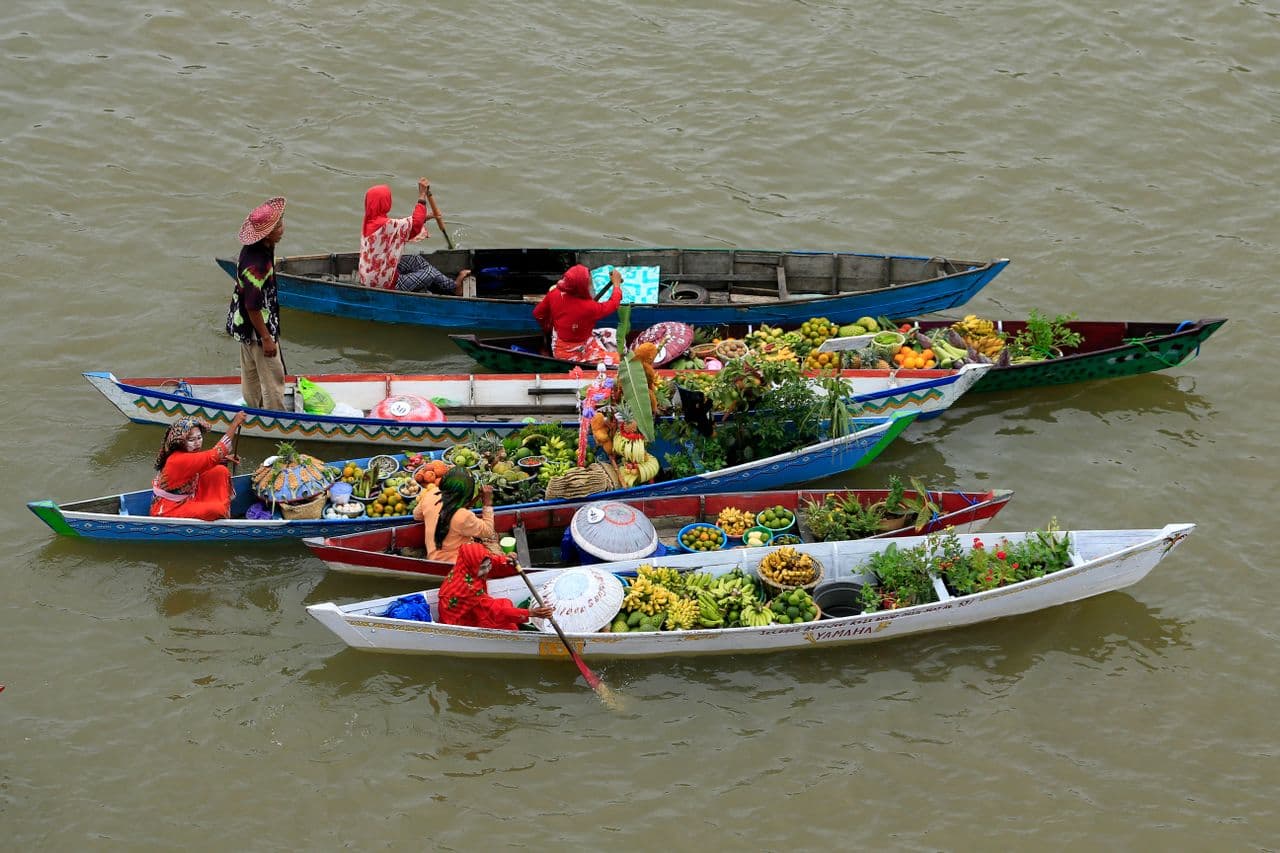
About thirty minutes by klotok from the center, this market gathers each morning female vendors in traditional tanggui hats on pirogues loaded with vegetables, fruit, and cooked dishes. It's one of Kalimantan's most authentic floating markets, less touristy than Muara Kuin.
Sultan Suriansyah Mosque
Considered the oldest mosque in South Kalimantan, it's built on stilts along the Kuin River. Its wooden architecture blends Javanese and local influences. It bears the name of Banjar's first sultan to convert to Islam.
Martapura Diamond Quarter
About 40 km from Banjarmasin, Martapura is home to the Cahaya Bumi Selamat market, specializing in cutting and selling precious stones mined from the Cempaka mines. You can observe cutters at work in small family workshops.
Barito River and Stilt Villages
A klotok excursion on the Barito reveals entire villages built over water, children diving from terraces, and fishing nets strung between pilings. The atmosphere glows particularly bright in late afternoon.
Etiquette and Visit Guidelines
Cover shoulders and knees when entering mosques; a sarong may be lent at the entrance.
Remove your shoes before entering any place of worship.
Ask permission before photographing vendors on pirogues.
Avoid eating or drinking in public during Ramadan.
Photography Tips
The floating market offers its finest light between 6 a.m. and 7:30 a.m., with morning mist hovering over the river. From the klotok's bow, frame pirogues against the light for expressive silhouettes. Sultan Suriansyah Mosque photographs beautifully from the opposite bank in late afternoon, when golden light strikes the structure's dark wood.
Location and Access
Banjarmasin is accessible by direct flights from Jakarta, Surabaya, and Balikpapan. Syamsudin Noor Airport is south of the city. Maritime connections link the city to Java via Trisakti port. Around town, the klotok remains the most practical way to explore the canals. Taxis and ride-sharing apps (Grab, Gojek) cover land travel.
Nearby
Martapura — the city of diamonds and precious stones, approximately 40 km to the east.
Lok Baintan Floating Market — the region's most lively floating market, accessible by pirogue.
Meratus Mountains — forest range inhabited by Meratus Dayaks, departure point for primary rainforest treks.
Pulau Kembang — river island populated by macaques, accessible by klotok from Banjarmasin.
Frequently Asked Questions
Frequently asked questions
The dry season, from May to October, facilitates boat travel and forest excursions. The rainy season (November to April) can cause floods that disrupt some floating markets.
Leave Banjarmasin before 6 a.m. to reach the market at dawn. Activity peaks between 6 a.m. and 8 a.m.; after 9 a.m., most vendors have left.
Klotoks are rented through hotels, local agencies, or directly at wharves in the city center. Negotiate the rate and duration before boarding.
Yes. Tanjung Puting rehabilitation center in neighboring Central Kalimantan province is accessible from Banjarmasin by short flight or boat journey. Plan for at least two additional days.
Access to pirogues and floating markets is difficult for people with reduced mobility. Land travel by taxi is more accessible, but sidewalks remain uneven in the old town.
Soto banjar (spiced chicken soup with vermicelli), ketupat kandangan (sticky rice with fish), and wadai (traditional Banjar cakes) are signature dishes to seek out in market warungs.
Want to discover this destination?
Our local advisors design your tailor-made trip.