Lombok: Mount Rinjani & Surroundings
At the summit of Rinjani, between emerald crater lake and natural hot springs
Duration
9 days
From
€795/pers.
Ideal seasons
Apr, May, Jun, Jul, Aug, Sep, Oct
Style
Guided tour
Comfort
classique
Travelers
Solo, With friends, Couple, groupe
The spirit of travel
Embark on an exceptional adventure in the heart of Lombok, between the mythical ascent of Mount Rinjani and relaxation on the paradisiacal beaches of the Gili Islands. This trip combines sports trekking, spectacular volcanic landscapes, immersion in traditional villages and discovery of pristine nature. You will reach the summit of Indonesia's second highest volcano at sunrise, enjoy stunning panoramas over the Segara Anak crater lake, relax in natural hot springs and trek through magnificent terraced rice fields.
After the effort, time to rest with several days on Gili Air, between white sand beaches, snorkeling among sea turtles and laid-back island atmosphere. A complete itinerary that blends adventure, nature, local encounters and relaxation in one of Indonesia's most beautiful settings.
The stages of your journey
Highlights
Day-by-day itinerary

Welcome to Lombok
Airport pickup at Lombok by your English-speaking guide and transfer to Sembalun, a village surrounded by vast plantations and majestic hills.
After settling into your Guest house, you will have some free time to soak in the peaceful atmosphere of the surroundings.

Climbing Mt Rinjani
You begin, in the morning, the first stage of the ascent of the famous Mt Rinjani (3,726 m). The first hour of walking over rolling hills crosses vegetable fields and agricultural areas. This is the easiest part of the entire trek. Once this area is passed and a small stream is crossed, the trail follows a 30-year-old project, when, under the reign of President Suharto, a road was under construction from Sembulan Lawang to Rinjani's crater lake. Fortunately, due to the fall of the regime and a lack of funding, this project was abandoned. What remained has been returned to nature, which gradually reclaims its former possessions. However, the lucky hiker benefits from many bridges crossing old lava flows, which makes the path very pleasant. There is a short stretch of forest trail at approximately 1,220 m, but after that, there is very little shade. The second hour continues along rolling hills through meadows. Post 1 (Pemantuan) has a shelter and is located at an altitude of 1,428 m, but most hikers stop at Post 2 (Tengengean, at 1,513 m), in order to have lunch on one of the bridges.
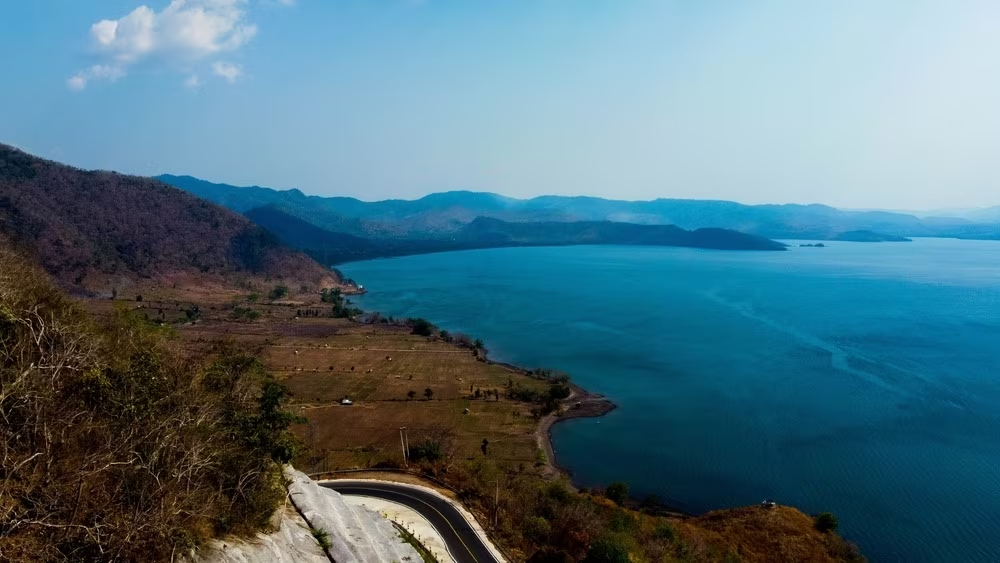
Post 3, Pada Balong, is located at 1,772 m altitude and it is from there that things become serious. The track becomes increasingly steep and the hike becomes difficult and exhausting. Over the next three hours, you will have to push yourself to gain altitude and for almost the entire duration of the climb, you will continuously see a summit which, to the disappointment of most hikers, turns out to be just another ridge. But when the final ridge is finally conquered, the hiker is rewarded with an absolutely magnificent panorama. The summit of Rinjani rises to the left, and just ahead, 600 meters below, lies the Segara Anak Lake (the child of the sea lake), which offers one of the most spectacular views in Indonésie.
The path then runs, for 20 minutes, along the edge of the crater to the final destination of the day - Sembalun Rim or Plawangan Dua (2,658 m) - where camp will be set up for the night. The crater rim offers plenty of comfortable space for many groups of tents. Following another path at the far end, you will reach a rocky cliff from which crystalline spring water flows. This is the ideal place to wash in the ice-cold water of a pure mountain spring and to refill your water bottles.

Ascent of Mt Rinjani
The first 350 meters departing from camp are quite steep and follow a fairly compact trail that crosses high-altitude vegetation. They then give way to purely volcanic gravel, from an altitude of approximately 3,000 meters. The first part of the route ends on the crater rim (2,969 m), offering an unobstructed moonlit view of Rinjani at the top, and of the crater edge all around.
The following 400 meters of altitude gain are very pleasant, with a trail that becomes slowly increasingly steep, but with a fairly compact surface. It is clear that being above 3,000 meters altitude slows your movements and your pace. Once again, the ridge offers unforgettable views and, as you climb higher and approach sunrise, the horizon gradually brightens. With each step, the summit seems to draw closer and yet you still have at least an hour to go and three hundred meters of elevation to climb.
For those who believe that Rinjani is a health walk, this is certainly not the case, as the final three hundred meters are truly pure volcanic climbing. The final stage, very steep, confronts you with very soft and deep sand that offers no grip. One step forward, ½ step back, and this for an hour that seems endless. Due to the high altitude, you must catch your breath every 10 meters before approaching the summit. At this stage, daylight has transformed the scene into a completely different atmosphere, as you can now clearly observe the entirety of the volcanic complex.
The final meters become a race against time and the approaching sunrise. Five meters further on, there is another rock - ideal for shelter from the wind if necessary - and another corner, from which you can see the next ridge, another rock and finally one last turn before passing one last small and narrow ridge to the summit of Indonesia's second highest volcano. The colors of the first hour after sunrise are simply breathtaking and change from minute to minute, offering unlimited opportunities for taking photographs. At this stage, it is essential to have a change of clothes, a spare t-shirt and a fleece jacket that will protect you from the often very hard, strong and cold trade winds. Avoid at all costs being at the summit before sunrise, unless you have very good high mountain protective clothing.
When descending, follow the same route back to camp, which will take you less than half the time it took you for the ascent. It is tempting to slide on the gravel and forget to continue admiring the magnificent views. The next stage to the lake itself is less physically demanding but rather technical as the surface can be quite slippery. The first hour of walking is very steep and slow. Eventually, the trail flattens out and leads through high-altitude meadows crossing several old lava flows overgrown with vegetation. After an hour, the lake gradually comes into view. The dramatic and jagged edge of the volcano surrounds and protects the lake in the center, while Rinjani to the east drops vertically nearly 1700 meters from the summit into the waters of the crater lake. Hiking: 9-10h Elevation gain: +1,070m / -1,710m

Return to Sembalun Lawang
The lake area (2,020 m) is not always very clean, as large groups of Muslim and Hindu pilgrims often use it as a resting point and leave behind large quantities of plastic and other waste. One of the main reasons for the importance of this camping area is the presence of hot springs (Aik Kalak), only a ten-minute walk away.
To find them, you must follow the opening of the lake where the waters overflow, cross the stream twice and follow the path for 200 meters down a very steep hill. Efforts have been made to build natural bathing pools by retaining the hot spring waters in natural basins to allow bathing. These basins are often filled with algae, however. The highest hot springs are also too hot for most hikers (and too dirty).
The large lower basin, with its two miniature waterfalls, is at ideal temperature and much cleaner. From these hot springs, you head north in late morning via Goa Susu ("milk cave", 1,885 m) to Torean, which is over 10 kilometers away, and where a vehicle awaits you to take you back to Sembalun Lawang.
Hiking: 4-5h
Elevation loss: -1,450m

Hot springs and rice fields
Early morning transfer to the natural hot springs of Sebau, an ideal place to relax after the hikes of previous days. You then continue towards the terraced rice fields of Sapit, through which you take a walk, in the heart of a lush landscape, between mountains and local cultures.
Walk: 2-3 hours

Last waterfall
Morning transfer to Tetebatu, a fertile region where you begin a short hike to a hidden waterfall: the Jeruk Manis falls ("sweet oranges" in Indonesian).
Nestled in the heart of a lush jungle, at the foot of Mount Rinjani, this spectacular waterfall is ideal for a final refreshing swim.
At the end of the day, transfer to the peaceful village of Kembang Kuning

Towards paradise
Morning transfer to Tetebatu, a fertile region where you begin a short hike to a hidden waterfall: the Jeruk Manis Falls ("sweet oranges" in Indonesian).
Nestled in the heart of a lush jungle, at the foot of Mount Rinjani, this spectacular waterfall is ideal for a final refreshing swim.
In the late afternoon, transfer to the peaceful village of Kembang Kuning

Feet in the water
Free day. You have the opportunity to spend the morning, for example, taking a tour of the island on foot or by bike. This excursion will allow you to discover the most peaceful beaches on the island as well as the small restaurants and bars by the water's edge.
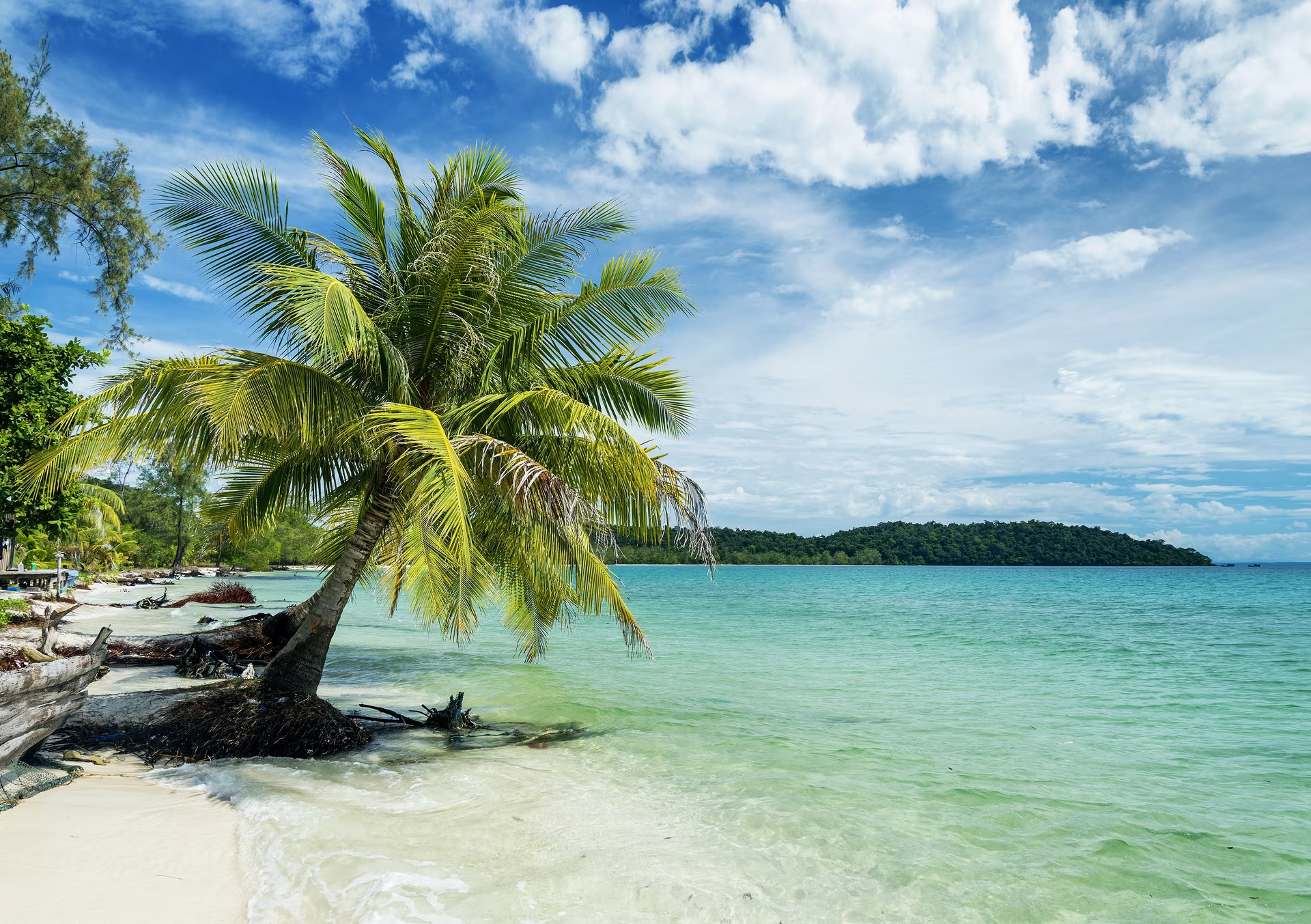
Also take your mask and snorkel and set off to meet the marine life departing from the beach. On the Gili islands, fish are plentiful but not only that. You will surely encounter several turtles during your snorkeling expedition, considered to be the oldest inhabitants of the island.
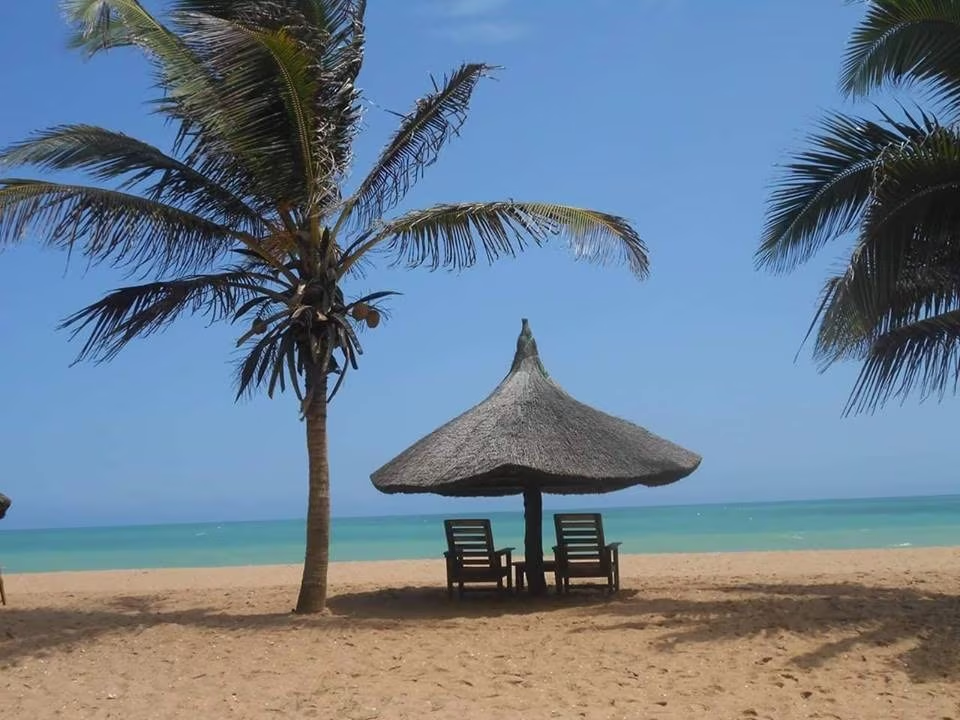
Also relax by sipping a cocktail or fresh coconut, your feet in the sand.

Price per person
Indicative price per person, based on double room. Each trip is customized according to your preferences.
This trip can be tailored to your preferences
This itinerary provides an excellent foundation for discovery, but it can be fully customized. Our local advisors build each trip tailored to your budget, dates and preferences.
Not included
- International flights and other domestic flights
- Visa(s) and possible airport taxes
- Insurance and assistance
- Beverages, personal expenses and tips
- Personal first aid kit
- Everything that is not mentioned in the "Inclusions" section
Included
- English-speaking guide
- Team of porters and cook
- Private vehicle transfers with air conditioning
- Maritime Transfers (Lombok-Bali)
- Full Board Accommodation in Lombok
- Accommodation in B&B at Gili Air
- Camping equipment (tents, mattresses and sleeping bags included)
- Site entrance fees, trekking permits and donations
- Mineral water, fruits and energy supplements during hiking days
Practical Information
Registration is considered firm and final after payment of a deposit of 30% of the total price and acceptance of the specific terms of sale.
The balance must be paid no later than 45 days before the departure date.
See our specific terms of sale for full details.
In the event of cancellation by the traveller, the following fees apply:
- More than 60 days before departure: 40% of the total price (deposit retained)
- Between 60 and 30 days before departure: 50% of the total price
- Less than 30 days before departure: 100% of the total price
We strongly recommend taking out cancellation insurance. See our specific terms of sale for full details.
The information below concerns tourists entering Indonesia. Entry requirements may change, and we recommend verifying the information with the official authorities of your country of residence and with the Indonesian embassy or consulate before your departure.
Passport
To enter Indonesia, your passport must be valid for a minimum of six months after your entry date and must contain at least two blank pages for immigration stamps.
The document must be in good condition (no damaged, torn or altered pages).
Tourist stay without visa
Depending on your nationality, you may be eligible for a visa exemption for tourist stays in Indonesia. Entry requirements vary by nationality and should be verified with the Indonesian embassy or consulate of your country of residence.
The authorities may also request:
an exit ticket from the territory (return or onward flight),
proof of sufficient financial resources for the duration of your stay.
Formalities on arrival
Before your arrival, it is recommended to complete the online arrival declaration via the official Indonesian customs and immigration portal (e-CD, Electronic Customs Declaration).
This form allows you to transmit to the authorities certain information necessary for entry into the territory:
passport information
flight details and itinerary
address of first accommodation in Indonesia
declaration of goods and currency carried
A confirmation QR code may be requested when passing through customs and immigration controls.
Health and vaccinations
No vaccine is mandatory to enter Indonesia, except in case of transit through a country at risk of yellow fever, in which case an international vaccination certificate may be required.
As a precaution, it is advisable to consult a doctor or vaccination center before departure. Vaccinations against hepatitis A, hepatitis B, typhoid and rabies are commonly recommended for stays in Indonesia. Antimalarial treatment may also be recommended depending on the regions visited (particularly outside Bali and major cities).
Travel with children
Minors must hold their own valid passport covering the duration of the stay.
In some countries, when a minor travels without one of their parents, an authorization to exit the territory may be required according to the regulations of the country of residence.
Entry requirements by nationality
Entry conditions vary depending on nationality. Travelers should consult the Indonesian embassy or consulate of their country of residence for specific requirements.
To participate in our trips, it is strongly recommended to be insured for repatriation assistance and medical expenses abroad.
Your local agency encourages you to familiarize yourself with the specific contract developed with our partner CHAPKA ASSURANCES and AXA ASSISTANCE.
To subscribe to insurance, find out about coverage and rates, follow the link below.
CAP EXPLORER: The complete insurance solution designed for a worry-free trip!
Choose the plan that suits you best:
Explorer'Multirisque
Explorer'Annulation
Explorer'Assistance
Explorer' Complémentaire Carte Bancaire
Specific to our trips, we strongly recommend subscribing to them.
If you choose to subscribe to one of these plans, the agreement detailing all coverage and the procedures for filing a claim are available on the insurer's website.
Your local agency will be aware of it, but only the participant is responsible for complying with the procedures for reporting any claim. The participant must therefore keep this agreement with them for the entire duration of their trip.
Chapka — Cap Explorer
Our insurance partnerTravel with peace of mind with our partner Chapka. Cancellation, repatriation, medical expenses, baggage… All the coverage for a worry-free trip.
Travel with peace of mind — I'll handle the insuranceFrequently asked questions
A Visa on Arrival (35 USD) is required upon arrival, valid for an initial stay and extendable once. You can also obtain an e-VOA online before departure. Your passport must be valid for at least 6 months from your entry date. Before booking, check the conditions applicable to your nationality with the consular authorities of your destination.
Go to the My Trips section to find all your projects.
You can send a message to your host directly from the Tea Lounge.
For a quality tailored trip, plan between 140 and 230 euros per day and per person, including accommodation, meals, internal transport and activities. International flights (700-1100 euros return) are additional. The archipelago allows you to combine beaches, volcanoes, jungle and culture at attractive rates.
Your documents are accessible in the Documents tab of your trip.
Absolutely. We tailor each circuit to the travelers' profile. For families, we prioritize relaxed paces, family-friendly accommodations, fun and educational activities, and comfortable private transfers. Our local English-speaking guides know how to capture children's attention with age-appropriate stories.
It's simple. You exchange with our local team to define your wishes, budget and dates. You receive a detailed itinerary proposal within 48 hours. You adjust every detail together until you get the perfect version. You confirm and travel with peace of mind. Your local agency remains available 7 days a week throughout your trip.
In case of emergency, contact your local agency immediately.
Payment is generally made in two installments.
Our agency is part of the Nomadays network, registered in France. You benefit from APST (Association Professionnelle de Solidarité du Tourisme) guarantee which covers 100% of your funds. Secure payment, repatriation insurance included, and English-speaking assistance 24/7 on the ground throughout your stay.

Let's talk about your adventure — Sunda Islands
Photographer of Indonesian volcanoes and trails, based in Yogyakarta
Before drawing up an itinerary, you have to observe, walk, listen to the locals and understand the place. Only then can an adventure trip remain authentic.
— Dominic